
A years-old social media post by Yair Netanyahu, son of Israeli Prime Minister Benjamin Netanyahu, has resurfaced online following a massive influx of migrants crossing from Morocco into Spain’s North African enclave of Ceuta. The renewed attention has fueled claims that Israel has long been pressuring Morocco to take over the Spanish territory.
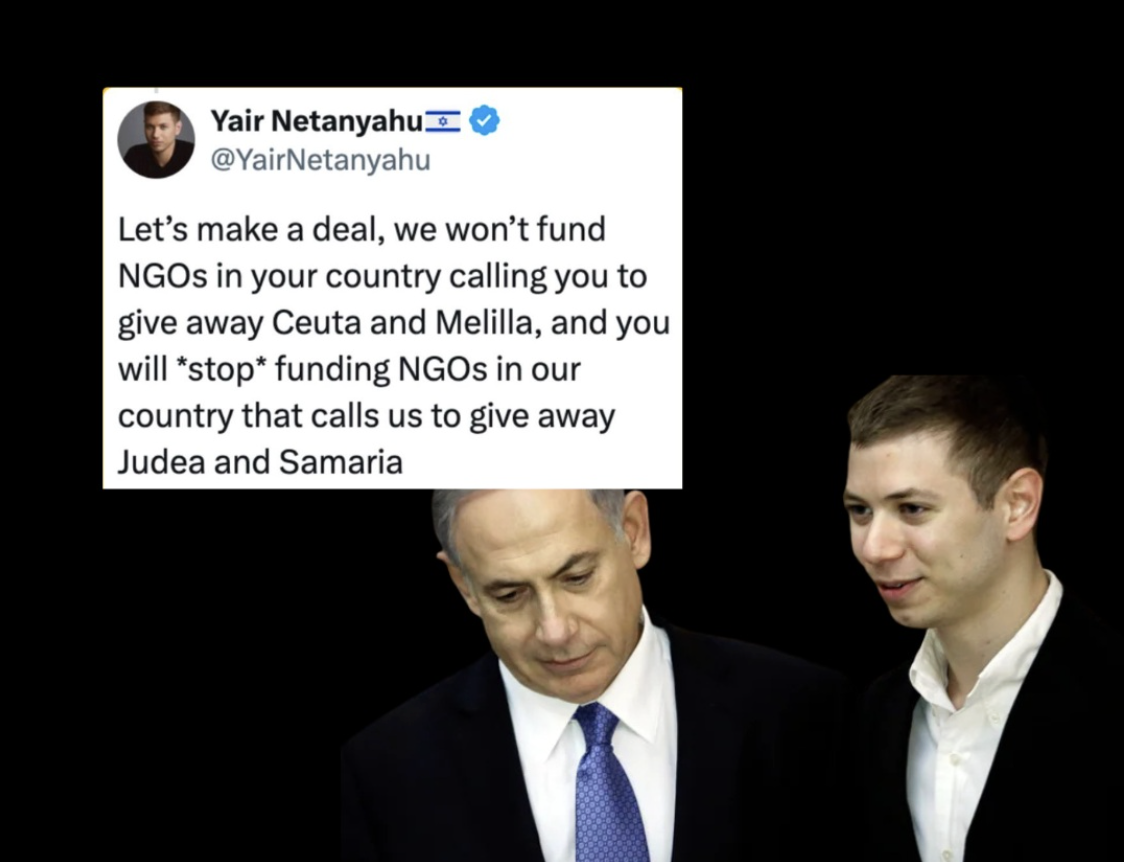
In 2019, Yair Netanyahu posted an image of Ceuta and Melilla, writing that Arabs and Muslims seeking to liberate Arab Islamic lands occupied by Israel should “start” there. The post has circulated widely in recent days as thousands of migrants overwhelmed Ceuta’s border, prompting Spain to deploy police and military reinforcements.
The tweet itself is genuine. Mainstream outlets say it has refocused attention on Israel-Spain relations, but claims of direct Israeli orchestration of the current crisis remain unverified and are circulating mainly as speculation online.
What Did Yair Netanyahu Actually Say About Ceuta?
The 2019 post proposed a tit-for-tat deal. Israel would stop funding NGOs in Spain that call on Madrid to surrender Ceuta and Melilla — if Spain stopped funding NGOs in Israel that call on it to surrender the West Bank.
Vox party leader Santiago Abascal condemned the post as irresponsible. Yair Netanyahu reportedly doubled down, saying Spaniards outraged by his comments should consider how Israelis feel about Madrid financing groups that support Palestinian statehood.
At the time, Spanish officials treated the exchange as an online spat, not a serious policy signal.
The Ceuta Border Crisis That Reopened Old Wounds
The renewed attention comes after tens of thousands of migrants reportedly crossed into Ceuta from Morocco within a 24-hour period. The disturbances eventually spilled over into Melilla overnight.
The surge followed a pardon by Morocco’s King Mohammed VI of more than 1,500 Moroccan prisoners. Spanish and Moroccan authorities have since moved to prevent further crossings, though Morocco has again been accused of deliberately relaxing border controls — a tactic Madrid says it has faced before.
Suspicions of political engineering also draw on a 2021 episode, when roughly 8,000 people entered Ceuta after Moroccan border controls appeared to ease amid a diplomatic dispute with Spain. That dispute was triggered by Madrid providing medical treatment to a Western Sahara Polisario Front leader. Spain’s then-defence minister described the episode as blackmail by Rabat.
Competing Theories on Israel’s Role in the Ceuta Crisis
Commentators online have linked the unrest to broader Israel-Morocco-Spain dynamics. An April analysis published in the Israeli outlet Ynet argued that the rift between the US and Spain had created room for Morocco to advance its territorial claims with Israeli backing.
Analysts also point to Morocco’s friendlier posture toward Israel compared with Spain. In 2024, Spain refused to allow a US-flagged cargo ship carrying weapons for Israel to dock at Algeciras, forcing the vessel to redirect to Morocco. That same year, Moroccan authorities allowed an Israeli warship to dock at Tangier to refuel after Spain had refused it port access.
Israeli officials have disputed claims of direct government involvement. Israel’s top diplomat in Spain, Dana Erlich, denied in April that the Israeli government was considering backing Morocco’s claims over Ceuta and Melilla, calling it “not a priority” for the Netanyahu government.
Israeli media have also treated the wider online narrative with skepticism. The Jerusalem Post reported that the loudest voices blaming Israel for the border disruptions have been conspiracy theorists rather than established journalists — noting that figures including far-right American commentator Candace Owens have shared Yair Netanyahu’s years-old posts as supposed “proof” of Israeli involvement. The outlet also noted that Spanish activists have separately advanced the theory that the crisis was engineered to undermine Spain’s left-leaning government.
Where the Ceuta-Israel Story Actually Stands
So far, there has been no independent verification of direct Israeli orchestration. The New York Times reported that some migrants said they were influenced by Moroccan police and social media posts urging people to gather at the border — pointing to a more localized explanation for the crossings.
What is beyond dispute: Yair Netanyahu did make the 2019 remarks. They have resurfaced repeatedly during past and present Ceuta-related tensions, continuing to shape public perception of Israel’s stance on the disputed Spanish enclaves — regardless of whether they reflect actual government policy.
It’s a familiar pattern. An unrelated crisis becomes the backdrop against which old social media posts suddenly take on new political relevance, blurring the line between documented statements and speculative claims of state-level orchestration.
Related stories:
Netanyahu Flies Over Four ICC Member States Despite ICC Arrest Warrant
Trump slams Netanyahu following US-Iran peace deal
Pakistan declares Netanyahu a “terrorist”
German Court Rules Comparing Israel to Nazi Regime Is Not a Criminal Offence
Hundreds protest Israeli resort project in Ostuni, Southern Italy