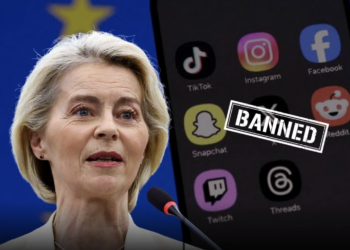


The European Union is moving toward a common framework for regulating children’s access to social media and other online services, with European Commission President Ursula von der Leyen announcing the proposed EU Kids Act during her State of the Union address on 16 September 2026.
The initiative would introduce different levels of protection according to age, rather than impose a blanket ban on social media for everyone under 18. Von der Leyen said the Commission would take a “gradual and differentiated approach”, with the formal proposal due to be presented on 17 September.
What the EU Is Proposing
At the centre of the proposed framework is a three-tier approach.
- Children under 13 would not be permitted to use social media.
- For those aged 13 to under 15, von der Leyen said only parent- or guardian-supervised “mini accounts” would be permitted, with limited features and time restrictions.
- From 15 to 18, young people could have personal accounts, but platforms would face stronger “safe-by-design” obligations.
This means the proposal is not an EU-wide under-18 social-media ban. Instead, it would establish different levels of access and platform responsibility depending on the user’s age.
The precise legal wording, however, remains subject to the Commission’s formal proposal and subsequent negotiations. Reporting based on preparatory documents before the announcement described a somewhat broader tiered model, including different provisions for younger children and restrictions on independent accounts below 15. Those details should therefore be distinguished from the framework publicly outlined by von der Leyen.
Beyond Conventional Social Media
The initiative is also broader than platforms such as Instagram or TikTok.
Preparatory documents reviewed by Reuters indicated that the proposed framework could cover social media, video-sharing platforms, AI chatbots and online games. Reuters reported that the working proposal included age verification, parental controls and obligations aimed at limiting addictive design, although the details were subject to change before the formal presentation.
The wider scope reflects an EU approach in which children’s online safety is not treated solely as a social-media issue. Digital services with different functions could face age-related obligations depending on their risks and the way minors interact with them.
Why “Safety by Design” Matters
A central element of the proposal is safety by design, the principle that platforms should build protections for minors into their services rather than rely exclusively on parents or children to manage risks after access has been granted.
Von der Leyen specifically criticized features that she said can encourage excessive use and said platforms should have to demonstrate that their services are safe for young users. She also referred to risks associated with harmful content and AI-generated sexualized images involving girls.
Earlier EU work has similarly focused on privacy-preserving age assurance, safer default settings and platform responsibility. The European Commission’s age-verification system is designed to allow users to prove they meet an age threshold without unnecessarily disclosing additional personal information.
Why the EU Is Acting Now
The proposal follows months of increasing pressure for stronger and more coordinated European action.
In July, the Commission received the final report of its Special Panel on Child Safety Online. The panel recommended stronger protections, including age-appropriate access to social media, privacy-preserving age verification and restrictions on features that can contribute to harmful or addictive use. Von der Leyen subsequently said the EU needed clearer minimum-age rules.
The Commission has also been developing an EU approach to age verification. Its age-verification solution became feature-ready in April 2026, providing a technical basis for age checks that can be adapted by member states and market participants.
National governments have meanwhile pursued their own initiatives. Spain has proposed restricting social-media access for under-16s and requiring effective age verification, while Austria has moved toward a legal minimum age of 14. France’s parliament approved an under-15 restriction in July, but France’s Constitutional Council subsequently blocked the legislation, citing concerns including freedom of expression and privacy safeguards.
The result has been growing pressure for a more coordinated European approach rather than a collection of different national systems.
A Policy Debate Already Underway
The proposed framework also enters an existing debate within the European Parliament.
In November 2025, Parliament called for an EU-wide digital minimum age of 16 for social media, video-sharing platforms and AI companions, while allowing access for younger teenagers with parental consent. It also supported privacy-preserving age-assurance mechanisms and stronger action against addictive design.
The Commission’s proposed age structure therefore does not simply reproduce Parliament’s earlier position. It introduces its own graduated model, including a prohibition on social media below 13, supervised mini accounts between 13 and 15, and stronger safety-by-design obligations for users under 18.
What Remains Unresolved
Several implementation questions will depend on the final legislative text.
These include how age assurance will operate across different services, how parental supervision will be verified, which online services will fall within each category, and how the new requirements will interact with existing EU digital legislation.
Preparatory reporting has also pointed to possible obligations on platforms concerning parental controls, harmful-content reporting and addictive design. But these details should not be treated as settled EU law until the Commission’s final proposal is published and subsequently negotiated.
The Legislative Road Ahead
The announcement does not itself create new EU-wide legal obligations.
The European Commission is responsible for proposing legislation, after which the proposal must proceed through the EU legislative process involving the European Parliament and the Council of the European Union, representing the member states. Negotiations can modify the Commission’s original text before any final legislation is adopted.
The Commission’s own announcement confirms that the EU Kids Act is being presented as a forthcoming initiative rather than an already applicable law.
The Road Ahead
The EU Kids Act marks a proposed shift toward a common European system for regulating how children and teenagers access social media and other online services. Its central idea is an age-tiered framework: no social media below 13, supervised and restricted access for 13- to under-15-year-olds, and stronger safety-by-design requirements for teenagers up to 18.
For now, however, these remain proposed rules. The formal legislative text and the negotiations that follow will determine how the framework is ultimately defined, which services are covered and what obligations platforms will face across the European Union.
Report by Shoaib Ahmed
Related stories:
Why Germany and Italy Blocked the EU’s Move Against Israel
EU pledges to deport undocumented migrants