
Iran is reportedly preparing to receive an initial shipment of approximately 400 Chinese-manufactured air defense missile launchers, a move that could significantly strengthen Tehran’s short-range air defense capabilities as regional tensions continue to escalate.
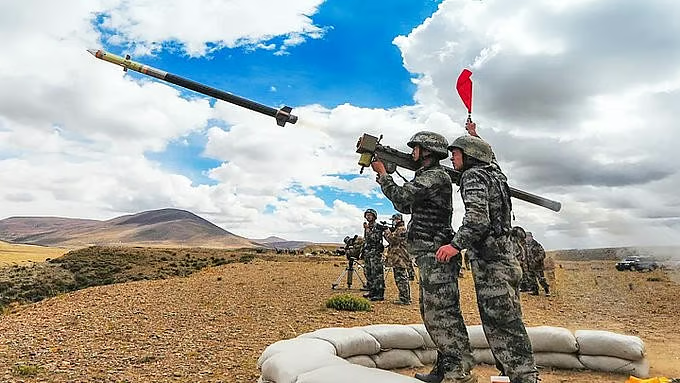
According to multiple reports citing sources familiar with the agreement, the shipment includes Chinese-made QW-12 and FN-16 man-portable air defense systems (MANPADS), with deliveries expected within weeks. The reported transfer comes as Iran seeks to rebuild its military capabilities following months of conflict with the United States and Israel, which exposed vulnerabilities in the country’s air defense network.
Neither the Chinese nor Iranian governments have publicly confirmed the reported delivery. China’s Foreign Ministry has dismissed reports of the transfer as “groundless,” while Tehran has not commented publicly.
Reported Missile Deal Could Bolster Iran’s Air Defenses
The reported agreement is believed to cover between 300 and 400 shoulder-fired surface-to-air missile systems, valued at approximately $60–70 million, making it one of Iran’s largest known acquisitions of short-range air defense systems in recent years.
Unlike long-range air defense systems designed to intercept ballistic missiles or high-altitude aircraft, MANPADS are portable missile launchers operated by individual soldiers. They are designed to engage helicopters, drones, low-flying aircraft, and cruise missiles at short ranges, making them particularly useful for protecting military installations, logistics hubs, and strategic infrastructure.
Military analysts say the systems could complicate future aerial operations by increasing risks for low-altitude aircraft operating over Iranian territory.
Why Iran Is Strengthening Its Air Defenses
The reported purchase follows months of military confrontation that exposed weaknesses in Iran’s layered air defense network.
During recent exchanges with the United States and Israel, Iranian military bases, missile sites, and strategic facilities were repeatedly targeted by precision airstrikes, highlighting gaps in Tehran’s ability to defend key infrastructure against advanced air power. The reported acquisition suggests Iran is prioritising rapid improvements to its short-range defensive capabilities while continuing to expand domestic missile production.
The acquisition also complements Iran’s long-standing strategy of developing a multi-layered air defense system combining domestically produced platforms with imported technologies.
China-Iran Defense Cooperation Deepens
If confirmed, the shipment would represent another step in the growing strategic partnership between China and Iran.
The two countries signed a 25-year comprehensive cooperation agreement in 2021 covering trade, infrastructure, energy, and security cooperation. Although military collaboration has historically remained limited compared with Beijing’s economic engagement, recent reports suggest defense ties have expanded amid heightened geopolitical tensions and Western sanctions.
Earlier this year, Reuters also reported that Iran was negotiating with China to acquire Chinese anti-ship cruise missiles, although neither government publicly confirmed that agreement.
For Beijing, maintaining strategic relations with Tehran supports its broader interests in Middle Eastern energy security and regional stability while strengthening partnerships outside the Western alliance system.
Regional Security Implications
The reported missile transfer comes at a sensitive moment for the Middle East.
Iran remains engaged in an increasingly volatile regional security environment following months of confrontation involving the United States, Israel, and several Iran-aligned armed groups. Strengthening Tehran’s air defenses could increase the cost of any future military operations against Iranian territory and influence strategic calculations across the region.
While the reported systems would not fundamentally alter the regional military balance, analysts say they could improve Iran’s ability to defend critical infrastructure against drones, helicopters, and low-flying aircraft, reducing vulnerabilities exposed during recent hostilities.
Questions Remain Over the Reported Delivery
Despite widespread reporting, several aspects of the reported deal remain unclear.
The exact delivery schedule, transportation route, final quantity of missile systems, and operational deployment have not been independently verified. Reuters reported that implementation details could still change, while Beijing has categorically denied the reports.
Whether the shipment proceeds as reported or not, the episode underscores the growing strategic importance of China-Iran relations and reflects Tehran’s continued efforts to rebuild its military capabilities amid an increasingly uncertain regional security environment.
Related stories:
US-Saudi Airstrikes Target Iran-Backed Groups in Iraq
Trump slams Netanyahu following US-Iran peace deal
Khamenei’s Ultimatum: Iran’s Three Preconditions for U.S. Engagement