
France publicly accused the United States of abandoning its role as a global human rights leader after Washington opposed a second term for UN human rights chief, Volker Turk. The public clash quickly spiralled out of control, resulting in a rare diplomatic walk out by US officials at the Security Council and exposing a widening rift between the two of the world’s closest allies.
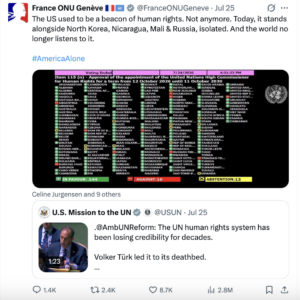
In a strongly worded post on social media, France’s UN mission in Geneva said the United States “used to be a beacon of human rights” but “not anymore,” adding that Washington now stands alongside North Korea, Nicaragua, Mali, and Russia. The harsh criticism sparked an uncommon diplomatic standoff between two of the closest allies in the world, which resulted in a US walkout at a UN Security Council meeting.
France’s Criticism After the UN Vote
The row goes back to an UN General Assembly vote on the reappointment of Volker Turk. The measure was passed by 144 states in favour, 10 votes against and 13 abstentions with the US among the opposing votes. France’s UN mission in Geneva responded on social media with unusually blunt language, saying the US “ used to be a beacon of human rights” but “ not anymore” and that it now stands alongside North Korea, Nicaragua, Mali and Russia is isolated with the world no longer listening to it.
US Walks Out of Security Council Meeting
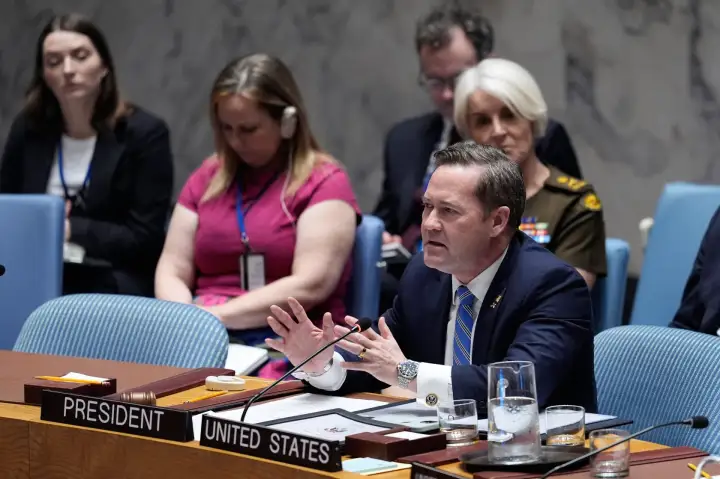
The rhetoric did not stay online long. The US delegation walked out of a Security Council meeting on Russian attacks on Ukraine as a French ambassador started speaking. It was widely seen as a symbolic gesture as the meeting’s agenda was not related. Deputy US ambassador Dan Negrea later explained the decision, calling France a “ disingenuous grandstander” that was feigning “ moral outrage” while lecturing the world on Ukraine and human rights. He said Washington had tolerated France’s approach in a “ sense of camaraderie and mutual respect as P5 members” but suggested that patience had run out.
Why the US Opposed Volker Türk
Additionally, US officials justified their objection to Türk’s reappointment.
Bartos, a Hungarian-American official, claimed that despite criticizing Israel more than any other nation, Türk had disproportionately attacked democratic nations including the United States, Britain, France, Australia, and Italy. Additionally, he said that the UN human rights office swiftly denounced US military action against Iran after remaining mute for 12 days amid a fresh crackdown by the Iranian regime.
Washington also denounced what US officials called a discriminatory database that targets American businesses and the office’s advocacy for removing sanctions on Cuba.
France’s Measured Response
When French Ambassador Jerome Bonnafont addressed the chamber, he took a notably restraint approach instead of escalating further. Instead of confronting the walkout directly, he appealed to the historic ties between France and the United States, including its role in America’s founding and it’s participation in July 4 celebrations marking the nation’s 250th anniversary. He said France’s ongoing role at the institution is informed by the spirit of the UN, created to work towards international peace and security, human rights and development.
Part of a Larger Pattern
This confrontation did not happen in a vacuum. This is part of a broader trend of the Trump administration moving away from UN bodies, having already cut finding to UN agencies and withdrawn from dozen of UN bodies. Washington has also threatened to reassess its funding and participation in connection with the Turk decision. The episode adds to a string of tensions between Washington and its European allies from disputes over NATO defence spending and the withdrawal of US troops in Europe to Trump’s calls for the United States to take control of Greenland, off the back of the UN.
What the Dispute Means
What this dispute means is not the walkout but what it signifies, two founding democratic allies at odds in the open over what human rights leadership should be, at a time when authoritarian states are watching closely. Rights advocates have warned the human rights post is more important than ever as autocracies gain influence around the world.
The practical consequence of traditional partners such as France and the United States no longer projecting united front on these issues may be less about who gets a UN job and more about whether the institution itself has any credibility to hold any government accountable.
Related stories:
UK, France, Canada Threaten Sanctions Over Israel’s Renewed Gaza Offensive
United Nations Overwhelmingly Approves Humanitarian Truce in Gaza
United Nations Examines South Africa’s Allegations of Genocide against Israel