
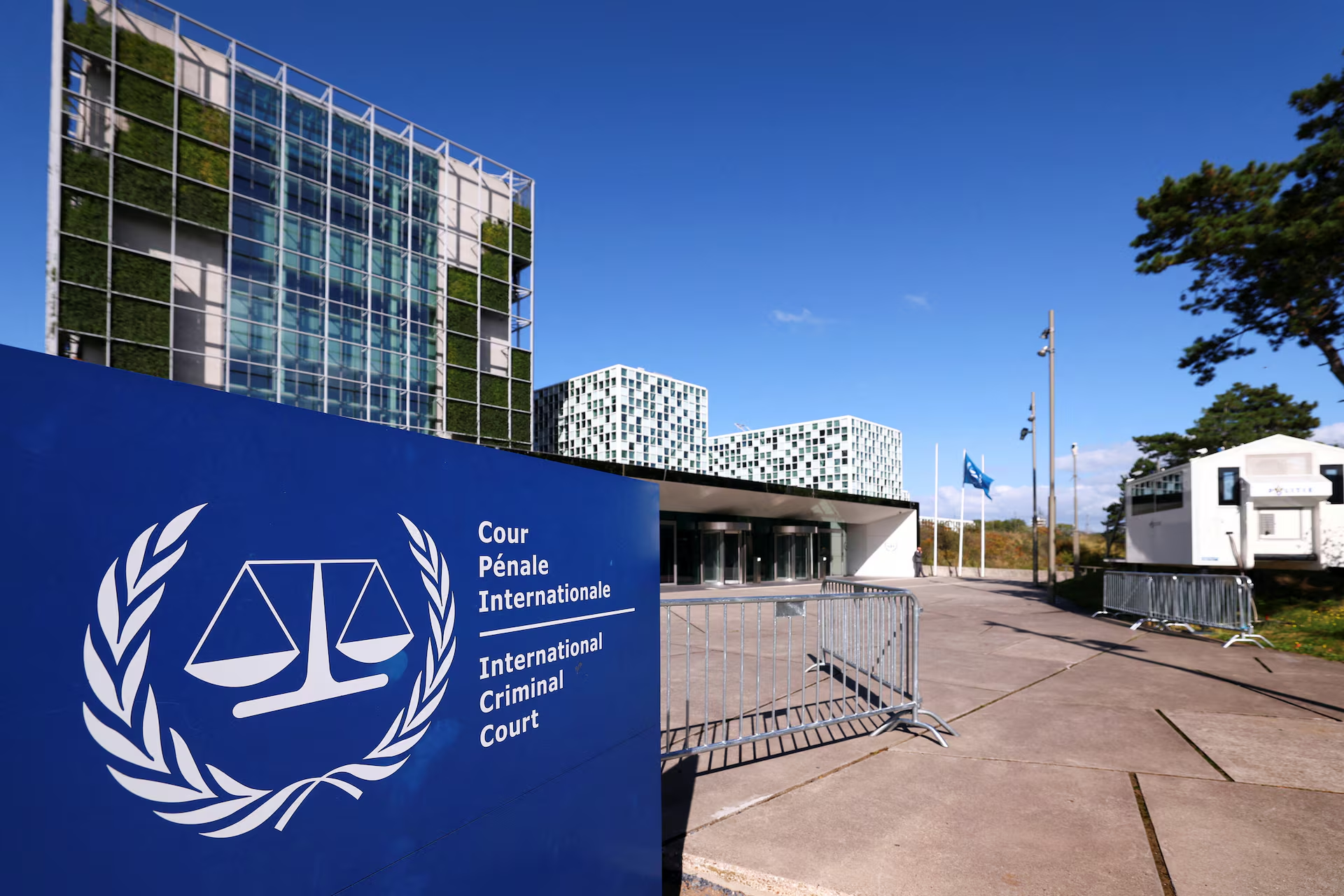
As Washington sanctions the International Criminal Court’s judges and prosecutors over Gaza-related war crimes warrants, the people it has targeted are turning to the one legal system the U.S. insists still has authority: its own.
The United States has spent more than a year arguing that the International Criminal Court has no jurisdiction over U.S. nationals or officials of countries that have not accepted its authority. This month, a very American irony caught up with that position: the officials Washington sanctioned are now asking American judges to decide whether the U.S. government broke its own laws while trying to prove that the ICC cannot reach it.
A CAMPAIGN TO DISMANTLE THE COURT
The dispute traces back to a single decision. In November 2024, ICC judges issued arrest warrants for Israeli Prime Minister Benjamin Netanyahu and his then-defense minister, Yoav Gallant, over alleged war crimes committed during the war in Gaza. Neither the United States nor Israel is a member of the court, and Washington has rejected the warrants’ legitimacy under both the Biden and Trump administrations. The ICC, however, says it has jurisdiction in the situation because of Palestine’s status under the Rome Statute and the alleged crimes committed on territory within the court’s jurisdiction. Palestine acceded to the treaty in 2015, and in 2021 ICC judges ruled that this gave the court authority over crimes committed on Palestinian territory, including Gaza, regardless of the nationality of the accused.
What changed under President Trump was the response. In February 2025, he signed an executive order authorizing sanctions against ICC officials involved in investigations targeting U.S. personnel or U.S. allies. ICC Prosecutor Karim Khan was among the first targets, after his office sought the warrants for Netanyahu and Gallant. The sanctions can freeze assets under U.S. jurisdiction and restrict U.S. persons and entities from conducting transactions or providing services to designated individuals. The campaign has widened steadily since.
On August 18, 2026, the administration sanctioned two more senior ICC figures: President Tomoko Akane, a Japanese judge who has led the court since 2024, and Abdoulaye Seye, a Senegalese senior trial lawyer. Washington accused them of participating in the court’s efforts to investigate or prosecute officials whose governments had not consented to ICC jurisdiction.
“The Trump Administration has been clear: the International Criminal Court is a corrupt and fatally politicized supranational court that has maliciously abused its authority and exceeded its mandate. We will not tolerate its assault on state sovereignty,” Secretary of State Marco Rubio said in a statement.
THE PEOPLE BEING SANCTIONED ARE SUING BACK
Sanctions of this kind are meant to isolate. Instead, they have produced a lawsuit filed inside the country doing the sanctioning. In June 2026, three ICC judges sued the Trump administration in a Manhattan federal court, arguing the sanctions were “arbitrary and capricious” and amounted to an attack on judicial independence, not from a foreign government, but through the machinery of U.S. law itself.
Human rights groups followed the same path. On August 11, Human Rights Watch and the American Friends Service Committee, the Center for Constitutional Rights and the Open Society Institute filed a separate suit challenging the sanctions on ICC prosecutors and judges, a United Nations human rights expert, and three Palestinian rights groups. Their argument is not primarily about the ICC’s authority abroad. It is about the consequences at home: the groups say the sanctions restrict Americans’ ability to engage in speech, association, legal advocacy and other work involving sanctioned officials and organizations, violating constitutional protections including the First Amendment.
THE ARGUMENT UNDERNEATH THE ARGUMENT
This is where the story stops being about the ICC and starts being about something more interesting: What limits a government must observe under its own legal system, even while denying that any other legal system has a claim on it.
Washington’s position has been consistent and, on its own terms, coherent. The ICC cannot bind a country that never joined it. But that argument was always about jurisdiction over foreign nationals and foreign conduct. The lawsuits now working through U.S. courts are not asking whether the ICC has authority over Americans. They are asking whether the U.S. government followed its own rules while punishing people for cooperating with a court it has decided to reject. That is a domestic constitutional question, and it does not go away just because the underlying dispute involves an international tribunal.
It is a strange position to defend: insisting that international law cannot reach you, while your own domestic law is actively being asked to judge how you behaved.
The question now is not whether the ICC can impose its authority on Washington. It is whether Washington can impose its sanctions without exceeding the authority granted to the U.S. executive under American law.
WHAT HAPPENS IF WASHINGTON LOSES ITS OWN CASE?
None of this settles what happens to the ICC’s Gaza investigation, which will proceed or stall largely on factors far outside any American courtroom. But it raises a question with a longer shelf life than this particular dispute: if a U.S. court eventually rules that the sanctions violated American citizens’ constitutional rights, does the administration accept that ruling with the same certainty it has demanded the ICC accept its own irrelevance? Or does the argument that no outside authority gets to judge Washington’s conduct turn out to have a domestic exception built in all along?
Related stories:
Netanyahu Flies Over Four ICC Member States Despite ICC Arrest Warrant
ICC seeks arrest warrants for top Taliban leaders in Afghanistan
Congress’ 2025 Priority: Protecting Netanyahu from arrest by Sanctioning ICC