


Chinese shipping company Sea Legend has launched a seasonal container service to Europe through Russia’s Northern Sea Route, opening a new route between China and Europe that can cut transit times by almost half.
The company plans eight sailings between China and Europe during the 2026 Arctic navigation season, with Ningbo-Zhoushan serving as the main departure point and Felixstowe in Britain among the destinations. The first vessel, the Dubai Tower, departed Ningbo on Aug. 15.
The service follows a trial voyage by Sea Legend last year, when the Istanbul Bridge travelled from China to Felixstowe in about 20 days.
A Shorter Route to Europe
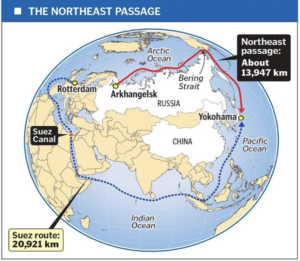
The Northern Sea Route runs along Russia’s Arctic coast and provides a shorter connection between northeastern Asia and northern Europe than traditional routes.
Sea Legend’s advertised transit time to Felixstowe is about 21 days. Conventional voyages can take around 40 days or longer depending on the route and conditions.
The time savings could make the route attractive for cargo where delivery speed is important, although the service remains seasonal and dependent on Arctic conditions.
Russia’s Role
The route also gives Russia a central role in the new service.
The Northern Sea Route is administered by Russia, with Rosatom responsible for its management and icebreaker operations. Ships using the route require Russian permits, making Moscow an essential part of the commercial corridor.
That dependence creates both logistical and geopolitical considerations for companies using the route, particularly because Russia remains under extensive Western sanctions.
What Is Being Shipped?
The service is expected to carry Chinese manufactured goods to European markets, including electric vehicles, lithium batteries and solar-related products.
The Arctic route could be particularly useful for time-sensitive cargo because of its shorter sailing distance. But the number of vessels using the route remains small compared with the large container fleets operating through the Suez Canal.
Why China Is Testing the Route
China has long promoted greater use of the Arctic as part of its broader “Polar Silk Road” strategy.
The commercial case for the Northern Sea Route has gained attention as disruptions and security risks have affected other major shipping corridors. A shorter Arctic connection could give Chinese exporters another option for reaching European markets.
But the route is not yet a year-round substitute for the Suez Canal. Seasonal ice, limited infrastructure, specialized vessels, insurance costs and the need for Russian cooperation remain constraints.
Environmental and Geopolitical Concerns
The expansion of Arctic shipping has also raised environmental concerns. Increased vessel traffic can contribute to pollution, underwater noise and black-carbon emissions in a region already experiencing rapid warming.
The route also carries geopolitical complications. Companies using it must coordinate with Russian authorities, a consideration that has become more sensitive as Western governments continue efforts to isolate Moscow.
South Korea is now testing the route as well. Its PanStar Acro began a commercial voyage to Europe on Aug. 22, the country’s first such Arctic voyage, in a test of the route’s commercial viability.
A Seasonal Alternative, Not a Suez Replacement
Sea Legend’s service marks a step toward more regular commercial use of the Northern Sea Route, but it remains limited in scale.
For now, the Arctic corridor is best viewed as a seasonal alternative for selected China-Europe cargo, rather than a replacement for established global shipping routes.
If more carriers follow Sea Legend and South Korea, however, the route could become a more regular feature of Asia-Europe trade.
Related stories:
10th Anniversary of Belt and Road Initiative: A Decade of Global Media Unity