
The 26th SCO summit, held in Bishkek from August 31 to September 1, 2026, marked the organisation’s 25th anniversary and concluded with the Bishkek Declaration, and 27 other adopted documents, alongside the handover of the chairmanship to Pakistan.
Read past the ceremony, the summit is a useful stress test: Iran, one of the SCO’s members, had faced direct military confrontation with the United States and Israel in the months before the meeting. What the bloc did, and did not, say about that conflict says more about the SCO’s real weight in a multipolar order than its founding charter does.
The SCO as a Structural Alternative, Not Just a Forum
Founded in Shanghai in 2001 by China, Russia, and four Central Asian states, the SCO has grown into the world’s largest transregional organisation, adding India and Pakistan in 2017, Iran in 2023, and Belarus in 2024. It is tempting, and wrong, to read it as an Eastern mirror of the G7.
The G7 brings together advanced industrial economies with broadly aligned political and security interests, while the SCO brings together states with far more divergent strategic priorities.
The SCO’s members don’t share much of that at all: India and Pakistan remain rivals inside the same bloc, China and Russia’s relationship carries its own asymmetries, and Iran’s theocracy has little in common with Kazakhstan’s or Kyrgyzstan’s governing systems. What holds the SCO together isn’t ideology. It’s a set of overlapping interests in security cooperation, connectivity, trade and a greater strategic autonomy from Western-led structures. That common ground is enough to keep ten very different governments at the same table.
Four Structural Features That Separate from BRICS
The SCO’s relevance rests on pragmatic cooperation rather than unity, that claim needs a comparison. BRICS is the obvious one, routinely name-checked alongside the SCO as if the two groupings were interchangeable. They function quite differently, and the gap is instructive.
The SCO has a standing security institution BRICS lacks: the Regional Anti-Terrorist Structure, based in Tashkent since 2004, which maintains shared intelligence lists among member states and coordinates joint exercises such as the recurring “Peace Mission” drills.
That gives the SCO an institutional security layer between summits that BRICS does not have. It’s worth being precise about what this actually amounts to, though: scholarship on RATS has long noted its formal budget is modest and its enforcement capacity limited, it is a real coordination mechanism, not a standing multinational police force. The institutional architecture is genuine; its operational muscle is more modest than the architecture implies.
The bloc also carries the “Three Evils” framework, centred on combating terrorism, separatism and extremism. It provides a common basis for security cooperation and information-sharing among members.And geographically, the SCO holds an advantage BRICS structurally cannot replicate: rather than stringing together four continents as a diplomatic signal, it covers one largely unbroken Eurasian landmass holding roughly 40 percent of humanity, which functions as an actual transit, energy, and security corridor rather than a purely symbolic coalition.
There is also a longer-running strategic pattern worth naming carefully. Since a 2005 SCO declaration called for a timeline on the withdrawal of U.S. forces from bases in Central Asia, some member states have consistently favoured limiting the long-term presence of Western military forces in the region.That is a documented tendency, not a binding treaty obligation, and it’s more accurate to describe the SCO as a bloc whose members have shared incentives to keep Western military presence out of their immediate neighbourhood than as a formal containment architecture with enforceable membership duties.
Put together, the SCO’s leverage over the G7-led order is less normative than infrastructural.
Its members collectively span a largely contiguous Eurasian space containing major energy and transport corridors, as well as a functioning, if imperfect, security architecture.Those are different kinds of power, and the SCO’s version is harder for outside actors to sanction away, even if it is also harder for the SCO itself to wield with the coordination a single great power can manage alone.
Iran as the Model
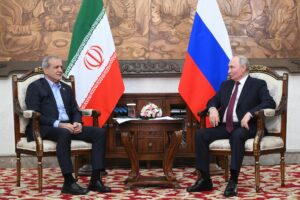
Iran’s membership since 2023 provides the clearest test of how far SCO cooperation can offset the effects of Western isolation.That test intensified after Iran fought direct confrontations with the United States and Israel in June 2025 and again in February 2026.
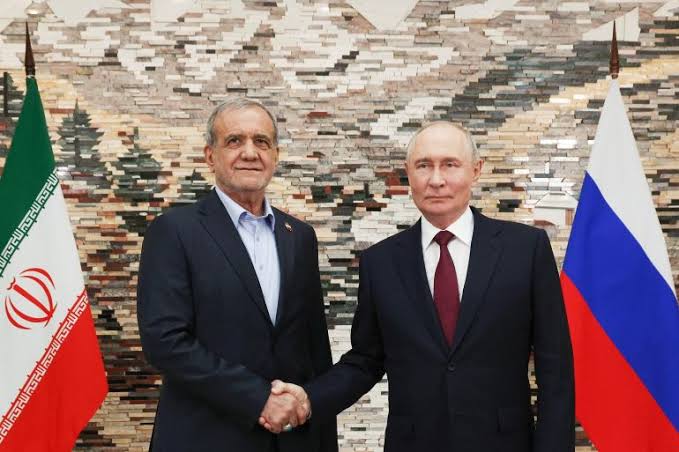
At the 2026 Bishkek summit, President Pezeshkian did not simply protest the strikes; he used the SCO’s institutional weight to reframe them as violations of the UN Charter’s prohibition on the use of force, while pointing out that a subsequent US-Iran memorandum collapsed within two weeks of signature, a fact he used to argue Iran, not Washington, had the more consistent record of compliance. The analytically significant move was venue choice: rather than relying solely on forums where Western powers have greater political and financial leverage, Tehran brought its case to a room containing China, Russia, India, and Pakistan, then used the sidelines for bilateral recalibration with Modi and Putin.
This matters beyond symbolism, but it has real limits. SCO diversification does not restore Iran’s access to SWIFT or Western capital markets, and nothing in Bishkek changed that.
What it does provide is something sanctions cannot easily eliminate: diplomatic space, political support from major non-Western powers, and continued avenues for economic and security cooperation, plus continued economic engagement on energy, transit corridors, and security coordination that keeps Iran’s isolation partial rather than total. The SCO isn’t functioning as a substitute for the Western financial system Iran has lost access to. It’s functioning as a pressure-relief valve against total exclusion, which is a meaningfully smaller, but still consequential, role.
What the 2026 Outcomes Prove About the Model’s Durability
The Bishkek Declaration, signed by all ten heads of state alongside 27 other documents, reiterated the SCO’s condemnation of strikes on Iranian territory without naming the US or Israel directly. That hedge is itself analytically telling: it demonstrates how the bloc can express collective solidarity while avoiding language that would commit all members to a direct geopolitical confrontation with Washington.
Institutionally, the summit did extend the architecture described above, though incrementally rather than dramatically. Leaders approved provisions for a new Universal Centre for Countering Challenges and Threats to the Security of SCO Member States, broadening the bloc’s security remit alongside RATS’ existing work.
English was also added as an official and working language, potentially widening the organisation’s diplomatic reach beyond Russian and Chinese.
Kazakhstan’s President Kassym-Jomart Tokayev said trade turnover among SCO countries was steadily approaching $1 trillion, while calling for fewer barriers, stronger transport links and deeper trade and investment integration. Uzbekistan’s president proposed, though has not yet secured, a joint development bank for regional infrastructure and resource projects, and Uzbekistan and China agreed to a target of raising bilateral trade from $18 billion in 2025 toward $30 billion in the coming years. The chairmanship’s handover to Pakistan, which will host in 2027, kept the rotation functioning despite the India-Pakistan rivalry sitting inside the same bloc.
None of this resolves SCO members’ bilateral conflicts or restores Iran’s Western market access. But it does demonstrate the model’s resilience under real stress: the SCO can absorb a member’s confrontation with a major Western power, provide that member with diplomatic space, and continue expanding its institutions without requiring its members to resolve their wider strategic differences.
That resilience may be the more important measure of the SCO’s growing weight. It is not an Eastern G7, nor is it a unified geopolitical bloc. Its significance lies in something more complicated: its ability to institutionalise cooperation among states that disagree on major strategic questions while still creating alternatives to a system dominated by Western powers.
Analysis by Tiara Dwi Kinanti
Related stories:
SCO Summit 2026: Key Takeaways from Bishkek
SCO Summit 2024 – Key Highlights
SCO Summit 2024: Cooperation Takes Center Stage in Islamabad