
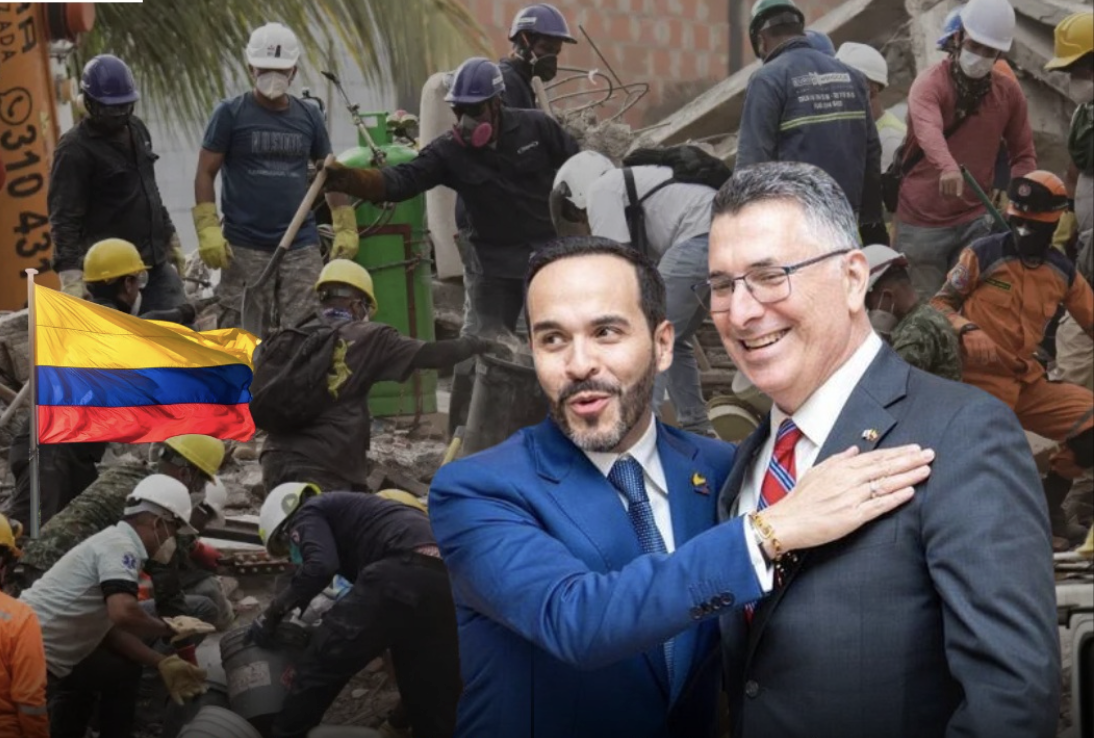
As Colombia races to respond to a devastating 7.4-magnitude earthquake, its decision to accept rescue teams from the United States, Israel, Ecuador and El Salvador, but reject or restrict assistance from countries such as Mexico, is raising questions over whether humanitarian aid is being shaped by politics.
A 7.4-magnitude earthquake has devastated Colombia, leaving communities in crisis and rescuers racing against time. But as the country searches for survivors, a second controversy is emerging: is Colombia deciding who can help based on political alignment?
Colombia’s government says it will accept specialized international search-and-rescue teams from the United States, Israel, Ecuador and El Salvador. All four countries are governed by right-wing or conservative administrations broadly aligned with Colombia’s new right-wing government.
At the same time, Colombia has restricted or rejected rescue assistance offered by countries including Mexico, prompting questions about whether the selection of international aid teams is truly based on technical requirements—or whether foreign policy is influencing a humanitarian emergency.
Colombia Says It Is About Rescue Standards
The government’s official explanation is technical.
UNGRD director David Tamayo said the international teams Colombia selected meet the standards of the International Search and Rescue Advisory Group, or INSARAG, an international framework for coordinating urban search-and-rescue operations following major disasters.
That is an important distinction. A major earthquake cannot be managed by simply allowing every foreign rescue team to arrive. Teams need specialized equipment, training and the ability to operate within an established command structure.
Colombia also has its own search-and-rescue capabilities, which was the government’s initial justification for declining foreign assistance.
But the question is no longer simply whether Colombia needs international help.
It is why some countries are being allowed to provide it while others are not.
Why Mexico’s Rejection Raised Eyebrows
The controversy intensified after Mexico said Colombia rejected its specialized rescue team.
Mexican President Claudia Sheinbaum said Mexico had offered a rescue brigade with experience responding to disasters, but Colombia did not authorize its deployment. Mexico subsequently shifted toward providing humanitarian assistance instead.
The decision immediately drew attention because Mexico is not politically aligned with Colombia’s new government.
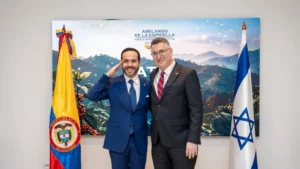
Mexico’s government is led by left-wing President Claudia Sheinbaum, while Colombia’s newly elected President Abelardo de la Espriella is a right-wing leader who took office only days before the earthquake.
That contrast has made Colombia’s decision politically difficult to explain.
The government says certification and operational requirements determined which teams could enter.
But when the accepted countries overwhelmingly belong to the political camp closest to Bogotá, the optics become harder to dismiss.
Four Countries, One Political Pattern
The four countries Colombia has agreed to receive are the United States, Israel, Ecuador and El Salvador.
Their governments differ in many ways, but all are led by leaders identified with the political right or conservative politics.
The United States is led by Donald Trump. Israel is governed by Benjamin Netanyahu’s right-wing coalition. Ecuador is led by Daniel Noboa, a conservative president, while El Salvador is governed by Nayib Bukele, whose administration has pursued a strongly security-focused and increasingly centralized model of government.
Colombia’s own new administration has also positioned itself firmly on the right.
None of this proves that ideology determined Colombia’s decisions.
But it creates a pattern that deserves scrutiny.
If technical qualifications were the only consideration, Colombia should be able to demonstrate that the same criteria were applied consistently to every country that offered assistance.
When Humanitarian Aid Meets Foreign Policy
International disaster assistance is never entirely divorced from diplomacy.
Governments build relationships through military cooperation, humanitarian missions and emergency assistance. Allowing foreign personnel into a country during a crisis also requires trust between governments.
But earthquakes present a particular challenge to that logic.
A collapsed building does not care which political party governs the country sending the rescue team.
Neither does a person trapped underneath it.
The purpose of international search-and-rescue operations is to bring additional expertise and equipment into a disaster zone when local capacity is overwhelmed or additional support could save lives.
That makes political filtering especially sensitive.
Colombia has the sovereign right to determine which foreign teams enter its territory. But sovereignty does not eliminate the need for transparency—particularly when decisions affect the speed and scale of emergency assistance.
The Clock Is the Real Enemy
The controversy is also about timing.
After a major earthquake, rescuers work against a rapidly closing window. The first days are critical for locating people trapped beneath collapsed structures, and every delay can complicate rescue operations.
Colombia initially declined foreign rescue assistance, arguing that it had sufficient domestic capacity, before later deciding to accept specialized teams from four countries.
The government may ultimately prove that the selected teams were the only ones that met its operational requirements.
But if that is the case, it needs to explain those requirements clearly.
Which certifications were required? Which teams failed to meet them? Were the same standards applied to Mexico and other countries? And why were the four selected countries approved?
These are reasonable questions, not accusations.
The Risk of Politicizing Disaster Response
There is a broader principle at stake.
Humanitarian disasters are among the few moments when international cooperation can transcend political divisions. Countries that disagree on trade, security or ideology can still work together when lives are at risk.
Turning that cooperation into an extension of political alliances risks undermining that principle.
It could also establish a troubling precedent: that humanitarian access becomes another instrument of foreign policy.
That does not mean Colombia should accept every offer of assistance. Poorly coordinated foreign teams can create logistical problems and place additional pressure on an already overwhelmed emergency system.
But the standard should be capability, speed, coordination and need, not political loyalty.
Colombia Needs to Answer the Question
The Colombian government may be completely correct that its decision was based on technical criteria.
If so, proving it should not be difficult.
Bogotá can publish the standards used to evaluate foreign rescue teams, explain why Mexico’s team was not accepted, and clarify how other international offers were assessed.
That transparency would settle much of the controversy.
Until then, the political pattern remains difficult to ignore.
Colombia is facing a humanitarian emergency in which the priority should be finding survivors and helping communities recover. But its decision over who is allowed to help has created a second crisis—one of credibility.
When lives are buried under rubble, the most important question should be who can save them fastest, not who shares your politics.
And that is why Colombia’s earthquake aid decision deserves scrutiny.
Related stories:
Latin America’s Leaders Push Implementation of the Isaac Accords