
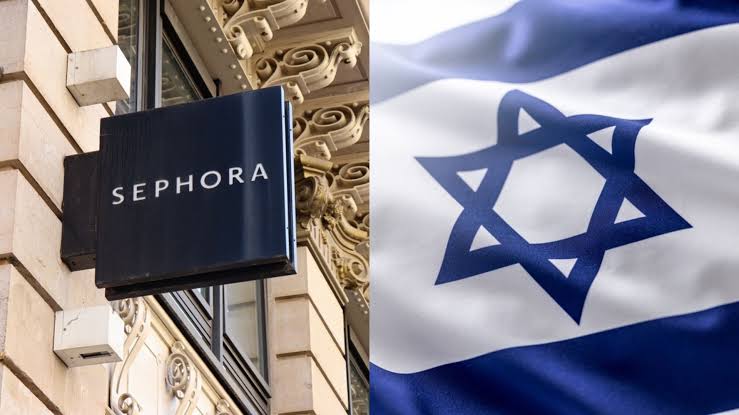
Sephora agreed to a temporary resale arrangement in Israel through local partner Glam42, without committing to opening official Sephora stores. Yet, within days, the arrangement was publicly framed as Sephora entering Israel, turning a cautious business experiment into a political narrative.
THE ANNOUNCEMENT
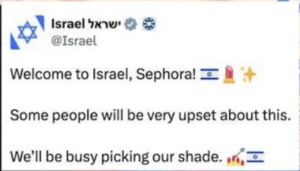
After Israeli media began reporting that Sephora was opening stores in the country, Israel’s Foreign Ministry posted on X: “Welcome to Israel, Sephora!” The post read like a diplomatic win, a global beauty giant choosing to do business in Israel despite years of pressure campaigns against companies operating there.
There was one problem. Sephora had not said it was opening stores in Israel.
THE DENIAL
On Wednesday, the LVMH-owned retailer issued a statement denying the reports. A company spokesperson said Sephora has no plans to open its own stores in the country. What Sephora confirmed instead was narrower: a temporary resale agreement allowing Sephora Collection, the retailer’s private-label line, to be sold through an Israeli beauty retailer called Glam42.
That distinction matters. A company opening its own stores is a deliberate corporate decision, one that carries the brand’s full name and full exposure. A temporary resale arrangement run through a local retailer is something else entirely: a limited, one-off commercial deal, structured specifically to keep Sephora’s exposure small. The Foreign Ministry collapsed that distinction the moment it hit publish.
WHAT IS ACTUALLY LAUNCHING
Local reports had said Glam42 would launch three locations at Tel Aviv’s Azrieli Center, Ramat Gan’s Ayalon Mall and Jerusalem’s Malha Mall, alongside five smaller ‘corners.’ Sephora subsequently clarified that these were not Sephora-owned or Sephora-operated stores. What all reports agree on is the assortment: Sephora Collection products only, with other LVMH-owned lines such as Benefit, Fresh, and KVD Beauty also expected to appear.
Israel’s cosmetics market is a real commercial opportunity. It was valued at roughly $390.6 million in 2025 and is projected to reach $408.5 million in 2026, growing toward $511.6 million by 2031. That is a reasonable business case for testing the waters carefully. It is not, on its own, a reasonable basis for a government to announce a brand’s arrival before the brand has confirmed one.
THE BRANDS LEFT OUT
According to Israeli outlet Ynet, several of Sephora’s most recognizable third-party brands will not be part of the initial rollout: Huda Beauty, Charlotte Tilbury, Rare Beauty, and Fenty Beauty. It would be easy to read that list politically, particularly Huda Beauty, whose founder Huda Kattan has been an outspoken supporter of Palestinian rights and whose past comments about the war drew accusations of antisemitism serious enough that critics called on Sephora to cut ties with her entirely. Sephora removed Huda Beauty from its Experts marketing campaign in August 2025 following the controversy, though it has continued selling the brand’s products in stores. The two are not the same decision, and conflating them would overstate how Sephora has actually responded.
But the beauty trade press has cautioned against reading too much into the omission. Distribution rights, import arrangements, and individual brand contracts can all determine what shows up in a new market launch, independent of politics. Rare Beauty illustrates the point well: the brand is entering Israel anyway, just through a pharmacy retailer’s parallel import deal that has nothing to do with Sephora’s arrangement at all. The absence of a brand from one deal does not mean the brand, or Sephora, made a political choice about it.
THE PRESSURE THAT IS REAL
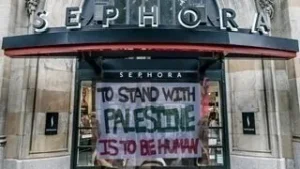
None of this happens in a vacuum. Sephora’s partnership with Glam42 comes as companies doing business in Israel face pressure from a boycott movement that has grown since the war in Gaza began following the October 7, 2023 attack. That pressure forms part of the wider commercial environment in which international brands are making decisions about operating in Israel, and helps explain why Sephora’s arrangement here took the form of a narrow, arm’s-length resale deal rather than a full-scale launch under its own name.
Related stories:
Israel’s Million Dollar AI Campaign Against Gaza
51 countries sponsoring Israel’s genocide
German Court Rules Comparing Israel to Nazi Regime Is Not a Criminal Offence