
Canada and China have reopened a military channel that had been dormant for more than eight years. The fifth round of the China-Canada Defence Coordination Dialogue took place in Ottawa on September 4, bringing officials from the two defence establishments together for the first time through the mechanism since April 2018.
The meeting was confirmed not by Ottawa, but by Beijing.
China’s Ministry of National Defense issued a statement the following day saying the two sides had held an “open and in-depth” exchange on international and regional security issues and expressed a willingness to expand practical military cooperation and mutual trust.
The Canadian government did not issue a comparable public readout. It confirmed the meeting only after journalists asked about it, describing the encounter as working-level military-to-military communication.
That difference in approach is worth noting, although it should not be overstated. Ottawa has said it does not routinely publicize working-level military meetings. The absence of a Canadian announcement therefore does not establish that the government was attempting to conceal the talks.
It does, however, leave Beijing’s account as the more detailed public record of what took place.
That is an awkward position for Ottawa at a moment when its relationship with China is being recalibrated after years of deterioration.
A Channel Frozen by the “Two Michaels” Crisis
The last time the two sides held this dialogue, Canada-China relations were about to enter their most serious crisis in decades.
In December 2018, Canadian authorities arrested Huawei executive Meng Wanzhou in Vancouver at the request of the United States. Within days, Chinese authorities detained Canadians Michael Kovrig and Michael Spavor.
Canada characterized the detentions as arbitrary. Kovrig and Spavor spent 1,020 days in Chinese custody before returning home in September 2021.
The episode, which became known as the “two Michaels” crisis, reshaped the political climate in Ottawa. Trust between the two governments deteriorated, economic disputes multiplied and military engagement with the People’s Liberation Army became considerably more difficult.
The Defence Coordination Dialogue had not been an especially ambitious institution to begin with. Established in 2013, it provided a channel for discussions on military issues and included areas such as maritime security, search and rescue, humanitarian assistance and disaster response. Four rounds were held before the mechanism fell dormant.
Its revival therefore represents a meaningful change, even if the September meeting itself remained at the working level.
Beijing Announced the Talks. Ottawa Did Not.
The most notable feature of the meeting is the information gap.
China’s defence ministry issued its public account on September 5. According to Beijing, the talks covered international and regional security issues, while both sides expressed an interest in strengthening military cooperation, mutual understanding and trust.
No equivalent Canadian defence readout was initially published.
That does not necessarily mean Ottawa was attempting to conceal the dialogue. Canada has not consistently publicized every working-level meeting under this mechanism, and the dialogue itself is part of a bilateral framework that predates the current thaw.
Still, the result is an information asymmetry.
For Canadians trying to understand the government’s China policy, Beijing initially provided the only detailed description of the meeting. Ottawa has said little about what was discussed or what it expects the dialogue to achieve.
That becomes more significant when viewed against the wider change in Canada-China relations.
Ottawa’s China Reset
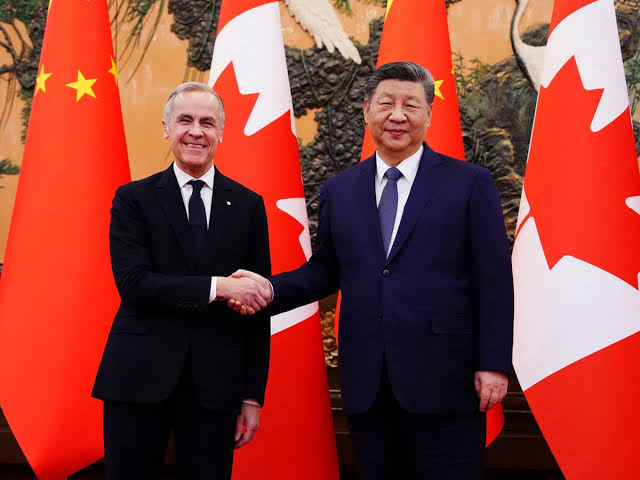
The military talks are part of a broader diplomatic shift under Prime Minister Mark Carney.
Carney travelled to Beijing in January 2026, becoming the first Canadian prime minister to visit China since 2017. The visit produced an updated Canada-China Strategic Partnership and a framework for renewed engagement.
The reset has not erased the disputes that have defined the relationship in recent years.
Canada continues to raise concerns with Beijing over foreign interference, human rights, forced labour and national security. Ottawa is also maintaining safeguards around areas it considers strategically sensitive.
At the same time, the two governments have moved to restore senior-level political dialogue and rebuild economic ties.
The pattern is therefore not straightforward rapprochement. It is closer to managed engagement alongside strategic distrust.
For Ottawa, the calculation is understandable. China is an important economic power and a central actor in the Indo-Pacific. Maintaining channels with Beijing gives Canada more room to protect its interests and manage disagreements.
But the security concerns have not disappeared.
Dialogue Without Trust
There is a practical reason for keeping military channels open even when governments remain deeply at odds.
Canada and China operate in an increasingly contested Indo-Pacific security environment. Canadian forces have expanded their presence in the region, while Chinese military activity around Taiwan and in the South China Sea has become a central concern for Canada and its allies.
Canadian and Chinese forces have also had direct encounters.
In October 2023, Canada accused Chinese military aircraft of conducting unsafe and unprofessional interceptions of a Canadian helicopter operating in the South China Sea.
These incidents illustrate why military communication can matter independently of the political relationship.
A working-level channel does not require either side to trust the other or accept its strategic position. It can provide a way to clarify incidents, raise concerns and reduce the risk that an encounter at sea or in the air becomes a larger diplomatic crisis.
In that sense, reopening the dialogue is not necessarily evidence of Canadian accommodation toward Beijing. It may simply reflect the realities of operating in the same increasingly contested region.
There is also a distinction between dialogue and military cooperation.
China’s statement referred to strengthening “practical exchanges and cooperation,” but that language is broad. The available public information does not establish that Canada and China have agreed to resume joint exercises, training, port visits or other forms of operational cooperation.
For now, the evidence supports a narrower conclusion: an established communication channel has been reopened.
The China Threat Has Not Disappeared
That reopening comes alongside some of Canada’s strongest security concerns about China.
Canadian intelligence agencies continue to identify the People’s Republic of China as a major foreign-interference and counter-intelligence challenge.
The Canadian Security Intelligence Service has described China as the most active state actor conducting foreign-interference activities in Canada in terms of scale and scope. It has warned about interference in Canadian democratic institutions, transnational repression and efforts to influence Canadian communities and political processes.
China has also sanctioned Canadian parliamentarian Michael Chong and members of a House of Commons human-rights committee in response to Canadian sanctions related to Xinjiang.
Those disputes remain part of the relationship.
The result is an increasingly complicated Canadian policy: Ottawa is attempting to restore communication with Beijing while maintaining safeguards against activities it considers a threat to Canadian national security.
The two positions are not necessarily contradictory. States routinely maintain diplomatic and military channels with governments they regard as strategic competitors.
The difficulty is explaining where engagement ends and accommodation begins.
The Washington Constraint
Canada’s China policy also cannot be separated entirely from its relationship with the United States.
Washington remains Canada’s central security partner. NORAD, NATO, intelligence-sharing and continental defence leave no serious ambiguity about the foundation of Canada’s security policy.
But relations with the Trump administration have become more difficult, particularly over trade.
That has increased the value of diplomatic and economic diversification for Ottawa.
China offers an obvious opportunity and an obvious risk.
A more functional relationship can give Canada greater economic and diplomatic room to manoeuvre. But Beijing is also a strategic competitor to Canada’s closest allies and a country whose military activities increasingly challenge the regional order in which Canada operates.
Ottawa therefore has to manage two relationships at once: maintaining the American alliance while building enough flexibility to engage other major powers.
That does not amount to choosing Beijing over Washington. It is a more conventional middle-power strategy of expanding room for manoeuvre without abandoning existing alliances.
Why Beijing Went Public
China’s decision to announce the meeting first adds another layer to the story.
Beijing has an obvious interest in demonstrating that its relationship with Canada is improving. Publicizing the return of defence dialogue supports that message and places the meeting within China’s broader narrative of restoring diplomatic ties with countries that have become more cautious toward Beijing.
Ottawa has fewer obvious reasons to make the meeting prominent.
The Canadian government can point to its established practice of not publicizing working-level military contacts. It may also prefer to keep the defence channel insulated from the political sensitivities surrounding China.
But the result remains unusual from a communications perspective: Beijing gets to describe the meeting before Canadians hear directly from their own government.
That matters less because it proves anything about Ottawa’s intentions than because it leaves room for different interpretations of the same encounter.
Beijing describes a willingness to deepen practical cooperation and mutual trust. Canada describes working-level communication.
Those descriptions may ultimately be compatible. But without a fuller Canadian account, it is difficult to know where the two sides see the boundaries of the relationship.
How Far Will Ottawa Take It?
For Canada, the case for maintaining military communication with China is relatively straightforward. Canadian forces operate in the Indo-Pacific, Chinese forces operate in the same waters and airspace, and the consequences of a serious miscalculation would not be confined to the two militaries involved.
The more difficult question is how far Ottawa intends to take the renewed engagement.
If the purpose is primarily to manage military incidents and maintain a reliable channel between defence officials, the revival of the dialogue is relatively uncontroversial.
If it becomes part of a broader normalization of defence relations, however, Canadians and Canada’s allies will reasonably want to know what that means.
For now, there is little evidence of a strategic realignment. The September meeting looks more like a cautious reopening of a channel that both governments had allowed to lapse.
But it comes at a consequential moment. Ottawa is simultaneously treating China as an important economic and diplomatic partner and as a serious national-security challenge.
That tension is unlikely to disappear.
The significance of the September meeting may ultimately lie less in what happened inside the room than in what follows outside it: whether Canada and China keep the dialogue narrowly focused on managing military risk, or use it as another step toward a much broader reset in their relationship.
Related stories:
China Now Viewed More Favorably Than the US, Pew Finds
26 leaders visit China in 2026