
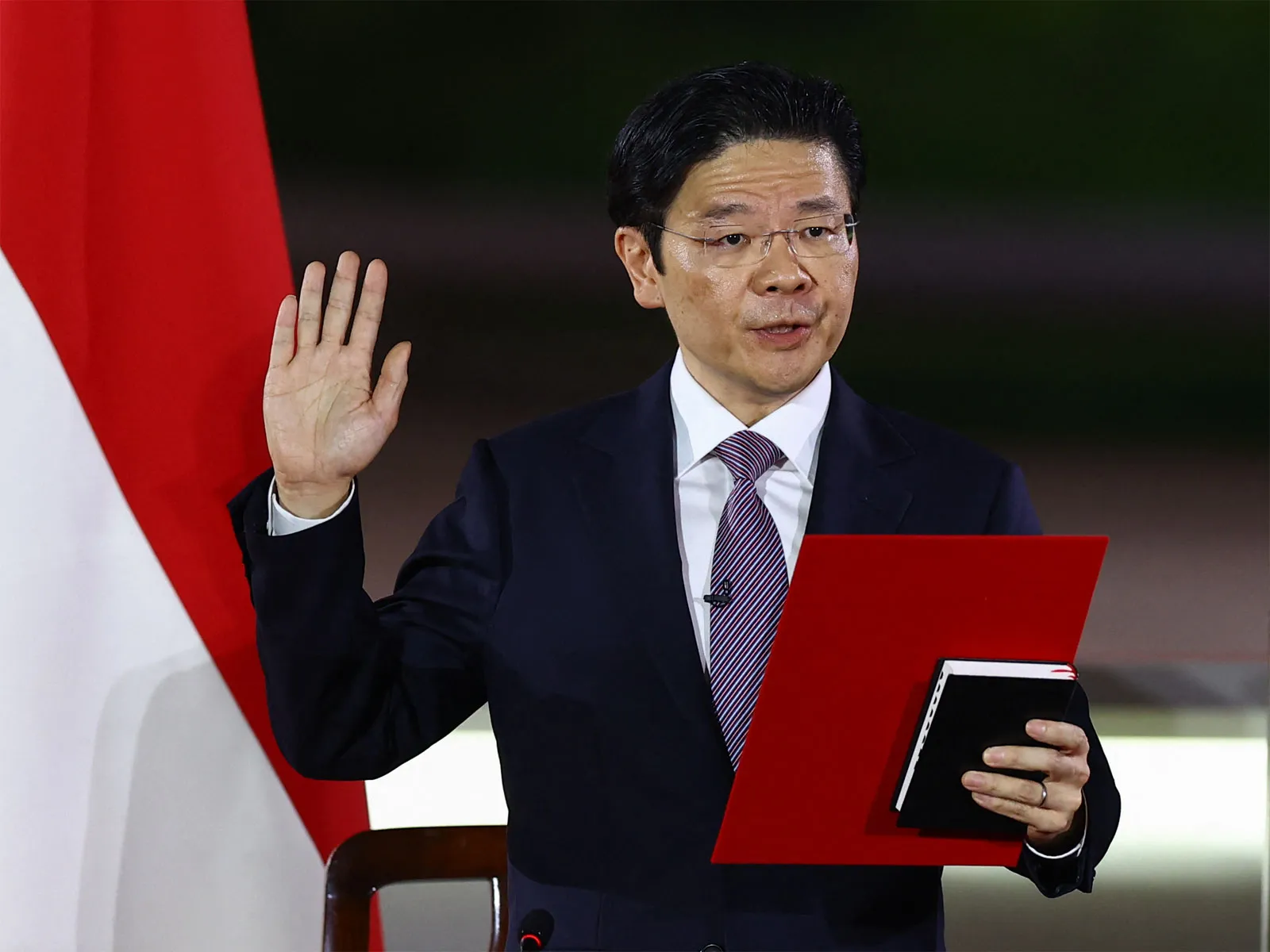
Singapore’s Prime Minister Lawrence Wong is set for a 64 percent increase in his annual pay package, widening an already extraordinary gap between Singapore’s political leadership and its counterparts in other major countries.
Wong announced in Parliament on September 8 that his annual compensation will rise from S$2.2 million to S$3.6 million, equivalent to approximately US$2.85 million.
The increase follows a 15-year freeze on ministerial salaries and will make Wong’s compensation more than seven times the statutory salary of US President Donald Trump and more than four times that of Swiss President Karin Keller-Sutter.
The figures are not perfectly comparable. Different countries structure political compensation differently, with some including allowances, bonuses or benefits that are excluded from statutory salary figures. Even so, the scale of Singapore’s package is difficult to overlook.
How Wong compares
Wong’s new compensation places him well ahead of other major political leaders.
| Leader | Country | Approx. annual pay |
|---|---|---|
| Lawrence Wong | Singapore | US$2.85 million |
| Karin Keller-Sutter | Switzerland | ~US$606,000 |
| Donald Trump | United States | US$400,000 |
| Anthony Albanese | Australia | ~US$390,000 |
| Mark Carney | Canada | ~US$275,000 |
| Christopher Luxon | New Zealand | ~US$260,000 |
| Keir Starmer | United Kingdom | ~US$230,000 |
Wong’s package is also greater than the combined statutory salaries of the leaders of the United States, Switzerland, Australia, Canada, South Korea and New Zealand, although those comparisons should be treated cautiously because national compensation systems differ.
The contrast nevertheless illustrates just how unusual Singapore’s approach has become.
Why does Singapore pay so much?
Singapore does not treat political salaries as conventional public-sector compensation.
Its system is explicitly linked to private-sector earnings. The benchmark salary for an entry-level minister, known as the MR4 grade, is based on the median income of the 1,000 highest-earning Singaporean citizens, with a 40 percent discount applied to reflect the public-service dimension of political office.
Under the new framework, that benchmark will rise from approximately S$1.1 million to S$1.8 million. The prime minister receives twice the MR4 benchmark, bringing Wong’s package to S$3.6 million.
The government’s argument is that Singapore must be able to compete with the private sector for political talent. Senior professionals in finance, business and other industries can command substantial incomes, and the government believes political office should not become financially unattractive to people with the skills it wants to recruit.
The model is also tied to Singapore’s emphasis on integrity in public administration.
The government describes its approach as a “clean wage” system, in which political officeholders receive a single salary rather than multiple personal salary components or hidden benefits. An officeholder receives only one political salary regardless of how many portfolios they hold.
A 15-year freeze ends
The latest increase marks a significant change after years of restraint.
Singapore’s ministerial salaries had remained unchanged for 15 years. The government’s latest review concluded that compensation needed to reflect changes in private-sector earnings and the broader remuneration environment.
But the new benchmark will not immediately translate into an equivalent increase for every minister.
Existing political officeholders will receive one-off adjustments of up to 9 percent from October 15, with individual increases determined partly by performance and the timing of their previous salary adjustments. Further increases will depend on performance and responsibilities.
For Wong, however, the new framework brings his annual package directly to S$3.6 million.
He has also pledged to donate the full increase in his own salary to charity for five years, assuming he remains prime minister.
The political cost of a high salary
Singapore’s model has always been politically sensitive.
The government argues that high compensation helps attract capable people into public service and strengthens the incentives for political leaders to maintain high standards of integrity.
But the argument becomes more complicated when political salaries are compared with the incomes of ordinary citizens.
Wong himself acknowledged the sensitivity in Parliament, describing political salaries as a “difficult and emotive issue” and noting that the amounts involved are considerably higher than what most Singaporeans earn.
That disparity is precisely why Singapore has emphasized transparency around the system. Rather than concealing additional benefits or relying on complicated compensation structures, the government openly publishes the framework and defends the principle behind it.
What Singapore’s model says about political leadership
The debate over Wong’s salary extends beyond one politician’s paycheck.
Singapore has made a deliberate choice to treat political leadership as a highly competitive profession, with compensation benchmarked against the country’s highest earners. It is a model built on the assumption that attracting and retaining capable political leaders requires the state to compete with the private sector.
Most countries have taken a very different approach. Political salaries are generally determined through public-sector or parliamentary frameworks and remain far below the compensation available to senior executives in the private sector.
Singapore’s system therefore stands out not simply because Wong earns more, but because of the philosophy behind the figure.
At US$2.85 million a year, Lawrence Wong’s new package will put him substantially ahead of Donald Trump, Anthony Albanese, Mark Carney, Keir Starmer and other major political leaders.
The question Singapore now faces is not whether its prime minister is the world’s highest-paid elected leader.
It is whether the public continues to see that premium as the price of attracting the people it wants to govern the country.
Related stories:
Singapore and China Announce 30-Day Mutual Visa Exemption