
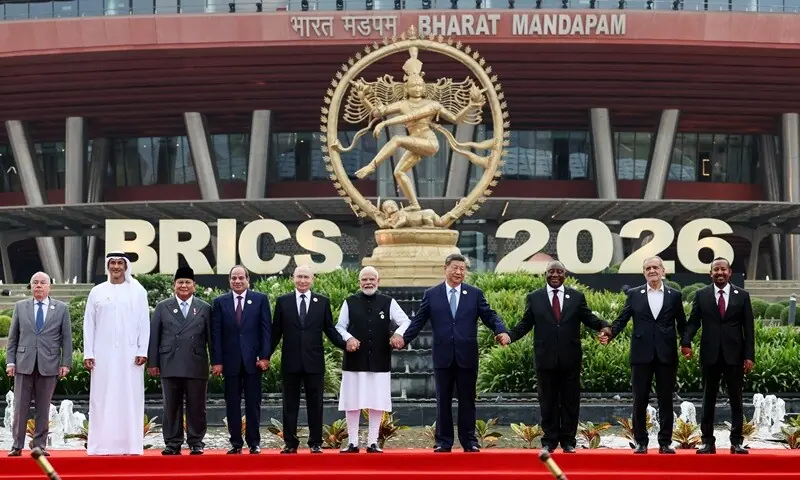
The 18th BRICS Summit was held on September 12–13, 2026, at Bharat Mandapam, New Delhi, under India’s 2026 BRICS chairship. The theme: “Building for Resilience, Innovation, Cooperation and Sustainability.”
Eleven members sat at the table: Brazil, Russia, India, China, South Africa, Iran, the UAE, Egypt, Ethiopia, Saudi Arabia and Indonesia. Together, the bloc represents roughly half the world’s population and around 40 percent of global GDP.
The summit produced one central document: the New Delhi Declaration, a 140-paragraph text adopted unanimously on September 12. The BRICS Business Forum preceded the leaders’ sessions on September 11, while several important diplomatic exchanges took place on the sidelines.
The Declaration: What It Actually Says
The New Delhi Declaration touched almost everything: UN and IMF reform, de-dollarization, sanctions, tariffs, the Pahalgam attack, the West Asia war, energy security, WTO paralysis, AI governance, and conflicts from Sudan to Syria. A few points stood out:
- No new BRICS currency. Despite years of speculation, the summit did not create a common BRICS currency.Instead, leaders backed greater use of national currencies in trade and investment and improved interoperability between payment systems. The direction is toward reducing reliance on the dollar—but it falls well short of creating a direct alternative to it.
- UN Security Council reform, explicitly.The declaration reaffirmed support for China and Russia’s existing permanent seats and backed a greater role for India and Brazil in the United Nations, including through Security Council reform. The language echoes positions expressed in earlier BRICS declarations.
- Tariffs and sanctions condemned but no one named. The bloc criticized unilateral tariffs and sanctions as inconsistent with international law and WTO rules. It also opposed carbon border adjustment mechanisms, the EU-style green tariffs several BRICS economies see as disguised protectionism. Not once did the declaration name the United States, even though Washington’s tariff war shaped the entire summit backdrop.
- Middle East: “maximum restraint,” no names. Leaders expressed deep concern over escalating tensions in West Asia and called for maximum restraint and protection of civilian infrastructure. The declaration avoided naming the US, Israel, Iran, or any Gulf state directly even as the region remained on edge, with Saudi Arabia reporting a drone strike on an oil pipeline and Houthi forces seizing a strategic Red Sea chokepoint in the days around the summit.
- The Pahalgam attack was condemned “in the strongest terms.” The declaration condemned the April 22, 2025 terror attack in Pahalgam, Jammu and Kashmir, which killed 26 people, and called for stronger international cooperation against terrorism financing, networks and safe havens. As with the 2025 Rio declaration before it, the text stopped short of naming Pakistan or identifying the location as Indian Territory, a familiar diplomatic compromise that let India claim a symbolic win without forcing other members, particularly China, into naming a strategic partner.
- AI governance featured prominently in the declaration, alongside language on energy security and the protection of cross-border energy infrastructure. The emphasis reflects the growing importance of both technologies and energy security to BRICS members.
Who Won
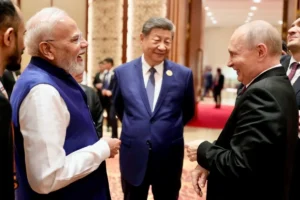
Narendra Modi. As host and chair, Modi secured unanimous agreement on all 140 points, no small feat given the bloc’s internal fault lines. Brazil and India tend to see BRICS as primarily economic; Russia and China treat it as geopolitical. Getting all eleven to sign one text, especially on the Middle East, was, in the words of Chatham House’s Chietigj Bajpaee, a reflection of BRICS’s real strength: its convening power, not its rule-making power. Modi framed it differently in his own remarks, calling the summit a “coming of age” moment for the bloc and insisting BRICS “is not against anyone” a deliberate rebuttal of Washington’s framing of the group as anti-American.
Xi Jinping. The declaration explicitly acknowledged China’s decision to extend zero-tariff treatment to more than 50 African countries, a concrete economic win that reinforces Beijing’s position as the preferred trade partner for the Global South.
Vladimir Putin. Putin attended in person, notable, since India is not a member of the International Criminal Court and carried none of the arrest obligations that kept him on videoconference at the 2025 Rio summit. He addressed the BRICS Business Forum before the leaders’ sessions, criticizing US and European sanctions over the Ukraine war and arguing the global economy was undergoing structural change. Reports from the forum describe the speech receiving loud applause as a signal, analysts say that Putin wanted to project: Russia is not isolated.
On the Sidelines
The formal declaration wasn’t where most of the summit’s real business happened. That took place on the margins, in meetings that never made the official agenda.
Putin’s forum speech, before the leaders even sat down. A day before the leaders’ sessions, Putin used the BRICS Business Forum, not the summit stage, to make his sharpest points on Western sanctions, a reminder that BRICS’s sidelines carry as much diplomatic weight as its official text.
Iran and the UAE, face to face. One of the most consequential sideline meetings brought together Iranian President Masoud Pezeshkian and UAE Crown Prince Sheikh Khaled bin Mohamed bin Zayed.
The Most Controversial Moment Wasn’t on the Agenda
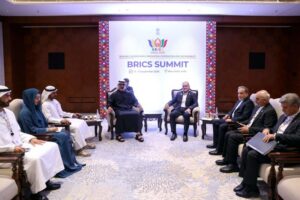
One of the summit’s most significant moments took place away from the formal agenda: Iranian President Masoud Pezeshkian met UAE Crown Prince Sheikh Khaled bin Mohamed bin Zayed. The meeting brought together two governments with sharply different regional interests at a moment of heightened tensions in West Asia, making it an important test of BRICS’s ability to facilitate dialogue among members with competing priorities.
The meeting wasn’t on the formal BRICS schedule. It was, by most accounts, tense. But its timing right before the declaration’s call for “maximum restraint” in the Middle East turned it into the summit’s most quietly significant moment. Analysts pointed to it as proof of BRICS’s real utility: not making rules, but keeping communication channels open between governments that otherwise aren’t talking.
Iran’s Pezeshkian also used the Business Forum stage to accuse the US and Israel of targeting civilians and civilian infrastructure, sharp language that the formal declaration itself carefully avoided.
What Was Left Unsaid
The summit’s diplomatic skill was less about what BRICS said than what it refused to say:
- No country was named over tariffs, even though India, China, Brazil and others have all been directly hit by US tariff escalation this year. India alone faces a 50 percent US tariff, including a 25-point surcharge tied to its continued purchase of Russian oil.
- No country was named over the West Asia war, despite explicit US-Israeli military action against Iran and Iran-linked strikes on Gulf States.
- No country was named over the Pahalgam attack, despite India’s own intelligence assessments pointing toward Pakistan-based networks.
Al Jazeera’s reporting from New Delhi summed up the pattern bluntly: BRICS members who have all, at different points, been targeted by unilateral US tariffs India, Russia, and China still chose not to name Washington directly, largely because several members, India especially, still need functioning bilateral relationships with the US.
Former Indian Foreign Secretary Nirupama Menon Rao described the outcome as a “significant diplomatic success,” achieved through carefully generalized language despite sharp underlying differences including between Iran and the UAE. That, analysts say, is both BRICS’s core value and its structural limit: it can keep a conversation alive and affirm broad principles, but it cannot assign blame or organize binding collective action.
What Comes Next
China takes over the BRICS chairship in 2027. The next test will be whether the bloc can turn the consensus achieved in New Delhi into concrete mechanisms for trade, finance, technology and diplomacy. Modi called the summit a “coming of age” moment. The question now is whether BRICS can move from declarations to implementation, or whether carefully negotiated, name-free language will remain the price of keeping such a diverse bloc together.
Analysis by Shoaib Ahmed
Related stories:
Iran Set to Join BRICS New Development Bank Amid Sanctions Pressure
China: BRICS Digital Currency Will Replace U.S. Dollar
BRICS Must Resolve India-Pakistan Tensions to Protect Its Credibility