
At the 18th BRICS summit in New Delhi this past weekend, President Xi Jinping announced that China will lead the creation of a BRICS open-source AI community: shared large language models, joint training programs, and an open ecosystem built for developing economies. China doesn’t formally chair BRICS yet, that happens in 2027, so this was less a decree than a pitch, Beijing staking its claim to the bloc’s AI agenda before it takes the wheel. But the message landed regardless: AI is no longer a side conversation at BRICS summits. It’s becoming the argument itself.
And the argument isn’t really about who builds the most powerful model. It’s about who gets access to it, who writes the rules governing it, who controls the infrastructure it runs on, and who actually benefits once it exists. That question runs through everything that follows.
CHINA’S PITCH, AND WHAT BRICS ACTUALLY AGREED TO
Xi’s proposal in New Delhi was broad: an open-source AI community, a digital ecosystem cloud platform for skills training, an engineer cultivation alliance, a youth exchange program in science and technology. The thread connecting all of it is participation. China isn’t asking the world to slow AI down. It’s asking who should get to participate in speeding it up.
It matters, though, that the bloc’s joint New Delhi Declaration did not adopt this proposal outright. It called more generally for cooperation on AI accessibility, safety, and reliability, language notably short of endorsing a China-led open-source initiative specifically. And BRICS isn’t internally unified on the subject either: Modi used his own remarks at the summit to warn against the “weaponisation of technology and critical minerals,” a line widely read as aimed partly at China’s own restrictive mineral export policies. Beijing has an ambitious vision for the bloc. Whether the rest of BRICS signs on to that vision, rather than just tolerating it, is still unresolved.
WASHINGTON’S ANSWER: AI AS A RACE TO BE WON
Washington’s posture is the mirror opposite. In July 2025, the Trump administration released “Winning the Race: America’s AI Action Plan,” a 90-point blueprint aimed explicitly at “unquestioned and unchallenged global technological dominance.” Where Beijing’s framing is about distributing access, Washington’s is about securing advantage, faster permitting for data centers, expanded chip exports to allied countries, and fewer domestic regulatory constraints on frontier labs, all built around a single strategic premise: whichever country’s AI systems become the default global infrastructure gains outsized leverage over everyone using them. That’s the geopolitical logic underneath the acceleration, not simply an appetite for speed, but a bet that being first sets the terms everyone else has to build around afterward.
THE PART OF THE WEST THAT DISAGREES WITH WASHINGTON
Here the story complicates. Washington’s posture is full acceleration. A meaningful part of the American AI industry itself is not nearly as confident that’s wise. In early September, former Anthropic researcher Jacob Coxon publicly estimated a one-in-ten chance that AI could extinguish humanity by 2030, and resigned from the company saying neither Anthropic nor its competitors were developing the technology responsibly. Days later, and within the same week as the BRICS summit, Anthropic CEO Dario Amodei called publicly for companies to “pace the frontier” of AI development, while OpenAI’s Sam Altman said AI progress “should be slower than it otherwise could be.” That’s not a fringe position: a 2023 statement warning that mitigating AI extinction risk “should be a global priority alongside pandemics and nuclear war” was signed by more than 350 researchers and executives, Amodei and Altman included.
Worth balancing that against the more cautious read: the 2026 International AI Safety Report, compiled with input from over 100 independent experts, found current systems show only early signs of the capabilities that would enable a genuine loss of control, and described the actual likelihood and timing of catastrophic risk as “unusually ambiguous.” The point isn’t that AI safety fears are settled fact. It’s that the loudest voices arguing for caution aren’t coming from Beijing or New Delhi. They’re coming from inside the same American companies Washington is racing to keep ahead.
WHAT ACCESS ACTUALLY MEANS FOR THE GLOBAL SOUTH
This is where the BRICS argument gets concrete rather than abstract. Technological dependency isn’t a slogan, it’s a specific, stackable set of gaps: computing power concentrated in a handful of countries with the capital to build data centers, AI models controlled by companies that decide pricing and access unilaterally, training data drawn overwhelmingly from wealthy-country internet usage, and a shortage of the technical skills needed to build or adapt systems locally rather than simply consume them. There’s a real, structural difference underneath China’s open-source pitch here: Chinese models are typically released open-weight, meaning any country can download, run, and modify them without needing the underlying training infrastructure. American frontier models like ChatGPT and Claude stay on their companies’ own servers, access and pricing controlled centrally. That’s not a minor technical detail. It’s the difference between a country being handed a finished tool and a country being handed the ability to build its own.
None of that guarantees developing economies gain a real seat at the table just because a more open model exists. Rules, standards, and governance frameworks are still being written largely by the countries and companies furthest ahead. But it does explain why “access” is doing real work in BRICS’s framing, not just diplomatic language.
THREE DIFFERENT ANSWERS TO THE SAME QUESTION
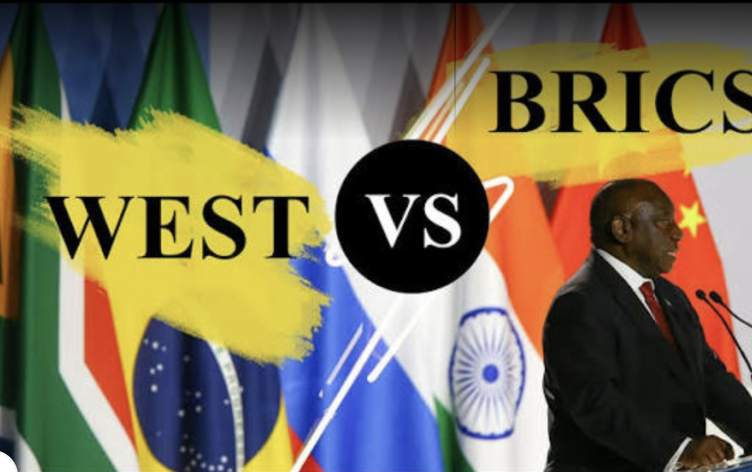
Strip away the summit language and there are really just three distinct answers to what AI is for. BRICS, led by China’s pitch, frames it as a resource that should be shared more evenly than it currently is. Washington frames it as a competition with a winner and a loser, where hesitation is the actual risk. A meaningful slice of the industry building the technology frames it as a safety problem first, where speed itself is the danger. None of these three actors is as internally unified as its own messaging suggests, BRICS has its own mineral-export tensions, Washington has its own industry pushing back, and the safety camp doesn’t speak with one voice either. That’s the more honest picture than a clean East-versus-West split.
THE REAL AI RACE
It would be simplest to end this by saying China and America will decide AI’s future between them. That’s probably wrong. The more consequential outcome may not be which country builds the single most powerful model, but who ends up controlling the rules, the infrastructure, and the distribution of what that model produces once it exists.
As China moves toward formally chairing BRICS in 2027, the bloc has a real opening, not a guarantee, to turn AI from a technology concentrated among a handful of powers into something developing countries have genuine agency over, rather than borrowed access to. Whether that opening becomes anything durable is still unproven. But the terms of the argument have already shifted. The question is no longer simply who wins the AI race. It’s whether the Global South gets a say in defining what winning was even supposed to mean.
Analysis by Tiara Dwi Kinanti
Related stories:
BRICS 2026: What Actually Happened in New Delhi
Iran Set to Join BRICS New Development Bank Amid Sanctions Pressure
China: BRICS Digital Currency Will Replace U.S. Dollar