
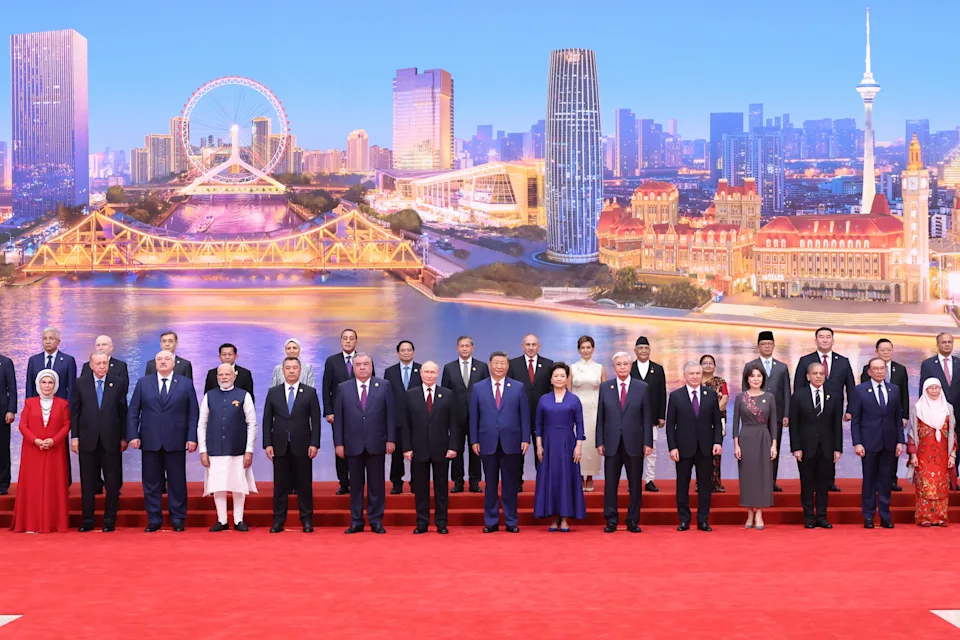
26 world leaders and government officials have visited China in 2026, highlighting its growing diplomatic and economic influence. As the US power slowly wanes, China has been steadily expanding its geopolitical influence. Government officials from Ireland, South Korea, Canada, Finland, the United Kingdom, Uruguay, Germany, Turkmenistan, Pakistan, Spain, the United Arab Emirates, Russia, Vietnam, Mozambique, Iran, Tajikistan, the United States, Seychelles, Moldova, Singapore, Serbia, Brazil, and Laos have travelled to China this year.
Notable visits
All of the major regions Europe (10), Asia (8), the Middle East (2), Africa (2), North America (2), and Latin America (2) have sent leaders to court China.
Among the most notable have been US President Donald Trump, Russian President Vladimir Putin, German Chancellor Friedrich Merz, Spanish Prime Minister Pedro Sanchez, Canadian Prime Minister Mark Carney, British Prime Minister Keir Starmer, and so on. Numerous executives have arrived in search of new investment prospects, easier access to the Chinese market, or collaboration in sectors like infrastructure, manufacturing, technology, and energy.
Leaders and officials from nations Beijing views as strategically significant allies, like as Pakistan and Russia, both of which sent several senior officials this year, have made several of the visits. Russia and China have particularly enjoyed a close relationship as both the nations share a joint view of multipolar world.
Expanding ties with Europe
With almost one-third of the nations on the list, Europe has been particularly well-represented.
Despite differences over trade, security, and China’s ties with Russia, visits by leaders of the UK, Germany, Spain, Ireland, and Finland indicate that European nations are keen to work closely with Beijing.
Realizing significance of China
In addition to signing cooperation agreements and investment deals, the flood of diplomatic trips to China has created in-depth, engaging experiences that challenge preconceived notions about the country.
World leaders are realising through in-person interactions and on-site inspections that relying solely on fragmented secondhand information to understand the nation is like “a blind man touching an elephant to guess its shape.” Even while these countries deal with quite different domestic situations, their main goals—securing stability, promoting collaboration, and generating possibilities for economic growth—remain very similar. Selecting China as a dependable and stable partner is becoming a strategic goal in an unpredictable world.
China as a dependable partner
China has established itself as a key stabilising influence in an extremely unstable international environment. Beijing has continuously expressed its opposition to a return to the law of the jungle in international governance by promoting credibility, respect for one another, and fairness.
Khalil Hashmi, Pakistan’s ambassador to China, noted that China has undoubtedly developed into a major center of international stability and referred to the country as a genuine “anchor” of such stability.Hashmi told CMG, “I think it is very obvious that China has emerged as an epicentre of stability” across social, political, and economic dimensions.
Related Articles:
China removes Israel from digital maps
Kazakhstan Joins Abraham Accords Signaling a Shift in Central Asian Diplomacy
Burkina Faso replaces European attire with traditional African attire