
For decades, international diplomacy was a quiet dance of balanced posture. Nowhere was this more evident than in India’s foreign policy, which historically walked a razor-sharp tightrope: championing the sovereign aspirations of the Palestinian people while carefully keeping the door open to pragmatism.
But geopolitics is rarely a story of permanent balances; it is a story of shifts.
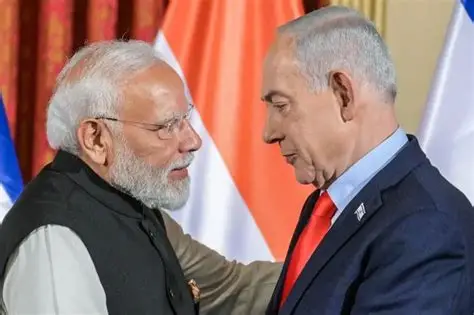
When Indian Prime Minister Narendra Modi stood alongside Israeli Prime Minister Benjamin Netanyahu in Jerusalem to elevate their ties to a “Special Strategic Partnership,” it was far more than a routine exchange of diplomatic pleasantries. To some, this moment represents the natural evolution of two resilient democracies merging tech, intelligence, and defense to survive in a volatile world. To others, looking through the lens of a deeply fractured Middle East and a mounting humanitarian crisis, it feels like a tectonic tilt—a definitive departure from historical neutrality toward an embrace of a government heavily criticized for aggressive military doctrine and hardline national ideologies.
At its core, this dynamic forces us to look past the dense language of bilateral trade agreements and defense frameworks, and confront a much more human reality. It begs the question of what happens when national interests begin to outpace global ideals, and how the choices made by leaders in air-conditioned boardrooms ultimately ripple out to alter the lives of ordinary people caught in the crossfire of history Ideological Parallels
Both Modi and Netanyahu share a vision rooted in nationalism that often sidelines democratic principles and human rights. Modi’s Hindutva ideology promotes a vision of India that prioritizes Hindu identity at the expense of its secular foundations, while Netanyahu’s administration has embraced a hardline stance against Palestinians, often justifying military aggression as necessary for national security. This ideological alignment fosters a dangerous synergy, where both leaders view their actions as justified in the name of national interest, often disregarding the humanitarian implications.
The recent defense cooperation agreement signed during Modi’s visit underscores this troubling partnership. By committing to a multiyear defense deal, India not only enhances its military capabilities but also legitimizes Israel’s ongoing military actions in Gaza, which have been widely condemned as violations of international law. This cooperation signals to the world that India, once a vocal advocate for Palestinian rights, is now complicit in Israel’s militaristic approach to governance.
Global Implications
The ramifications of this alliance extend far beyond the borders of India and Israel. As these two nations strengthen their ties, they risk destabilizing the already volatile Middle East. The partnership could embolden other authoritarian regimes to adopt similar nationalist policies, further eroding global norms around human rights and democracy. The Modi-Netanyahu alliance represents a shift towards a more militarized and ideologically driven international landscape, where power is prioritized over diplomacy.
Moreover, the collaboration between these two leaders may embolden extremist factions within their respective countries, leading to increased intolerance and violence against minorities. In India, the rise of Hindu nationalism has already resulted in heightened tensions between communities, while in Israel, Netanyahu’s government has fostered an environment where extremist views against Palestinians are increasingly normalized.
As the world watches this alliance unfold, it is crucial for the international community to remain vigilant. The Modi-Netanyahu partnership is not merely a bilateral agreement; it symbolizes a broader trend towards the normalization of extremist ideologies in global politics. The consequences of this alignment could jeopardize efforts to achieve peace in the Middle East and undermine democratic values worldwide.
In conclusion, the Modi-Netanyahu alliance is a cause for concern, as it represents a convergence of two nationalist agendas that prioritize military strength and ideological purity over human rights and global stability. As these leaders continue to strengthen their ties, the potential for conflict and unrest grows, necessitating a concerted response from the international community to uphold the principles of peace and democracy.
Related Stories
Quietly Redesigned By BJP: Whose Nation is India Now?
China removes Israel from digital maps
Hamas Agrees to Gaza Ceasefire Draft; US and Israel Reject Offer