
In 2024 ICC issued arrest warrant for Israeli prime minister, Benjamin Netanyahu and the country’s former defence minister Yoav Gallant. As perpetrator of “the war crime of starvation as a method of warfare; and the crimes against humanity of murder, persecution, and other inhumane acts,” the panel determined that there were good reasons to suspect Netanyahu criminal guilt. Ever since Netanyahu has been banned from 124 countries which have signed the agreement and will be arrested if he travels to one of these countries.
ICC’s Arrest Warrant
The International Criminal Court arrest warrant for Israeli Prime Minister Benjamin Netanyahu has changed things in the world of diplomacy. This warrant has really limited Benjamin Netanyahus ability to travel.. The story of how this warrant will be enforced is not simple. The world is not united on what to do with Benjamin Netanyahu. Instead each country has its way of dealing with the International Criminal Court arrest warrant for Benjamin Netanyahu, based on what the law says what the people in the country want and who their friends are, in the world.
Restrictions on Diplomatic Freedom
The core impact of the ICC warrant is the reduction of Netanyahu’s travel options. Under the Rome Statute, all 124 ICC member states are legally bound to detain and extradite individuals facing valid warrants. This legal reality turns routine diplomatic visits into high-stakes legal gambles. Consequently, Netanyahu must meticulously vet his travel destinations, heavily relying on non-signatory nations—such as the United States—to engage in face-to-face diplomacy without the immediate threat of arrest.
Nations Committing to Enforcement
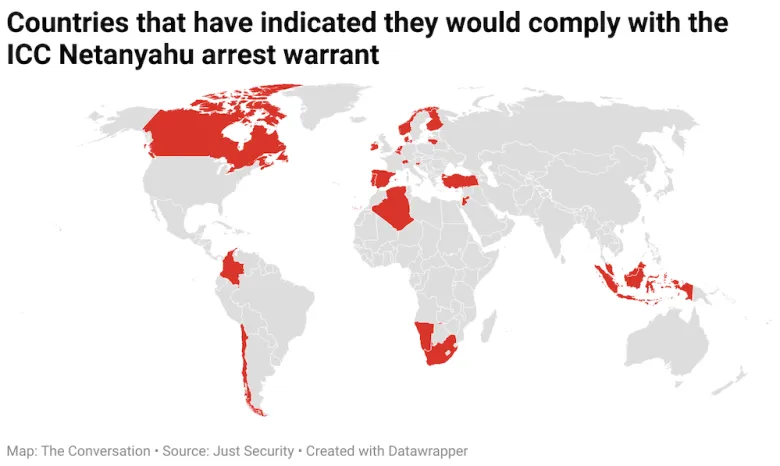
Several ICC member states have publicly affirmed their commitment to upholding international law, explicitly stating they would execute the warrant if Netanyahu entered their territory:
-
The United Kingdom and Ireland: Downing Street has stated it will “respect” the independent judicial process, while Ireland’s leadership described the warrants as an essential step toward accountability, confirming their intent to comply with ICC directives.
-
Italy: While initially debating the interpretation of the ruling alongside allies, high-ranking defense officials noted that Italy, as a state party, would legally be required to carry out the arrest.
-
Hungary (Recent Shift): Following a major political shift under Péter Magyar, the Hungarian parliament voted overwhelmingly to halt a previously initiated exit from the ICC. Magyar explicitly stated that under his government, Hungary would fulfill its legal obligations and take Netanyahu into custody if he entered the country. Other countries include:
- Belgium
- Canada
- Denmark
- Finland
- Iceland
- Lithuania
- Netherlands
- Norway
- Slovania
- Spain
- Sweden
- Switzerland
The Reality of Fractured Compliance
However, the Israeli Prime Minister is not in a situation where every country in the world is waiting to arrest him. The International Criminal Court or the ICC does not have its own police to enforce its decisions. The ICC’s judgement is non-binding and it cannot forcefully impose its decisions. Countries often care more about what is good for them than about following international law. Despite the official declaration, countries might have just released the statement to show compliance with ICC.
It is also hard for the ICC to get its way because of politics. Some countries, like the United States do not want the ICC to have power over them. The United States has even punished ICC judges and prosecutors. Some countries that are part of the ICC have to choose between doing what the ICC says and doing what their friends want. This shows that the ICC can say what it wants. The division reveals that it might be easy to create a legal barrier but its implementation remains largely dependent on the great powers who secretly control the system.
Related Stories:
China removes Israel from digital maps
Modi-Netanyahu Alliance: A Peace Threat
Zohran Mamdani Calls India’s Modi a “War Criminal,” Comparing Him to Netanyahu