
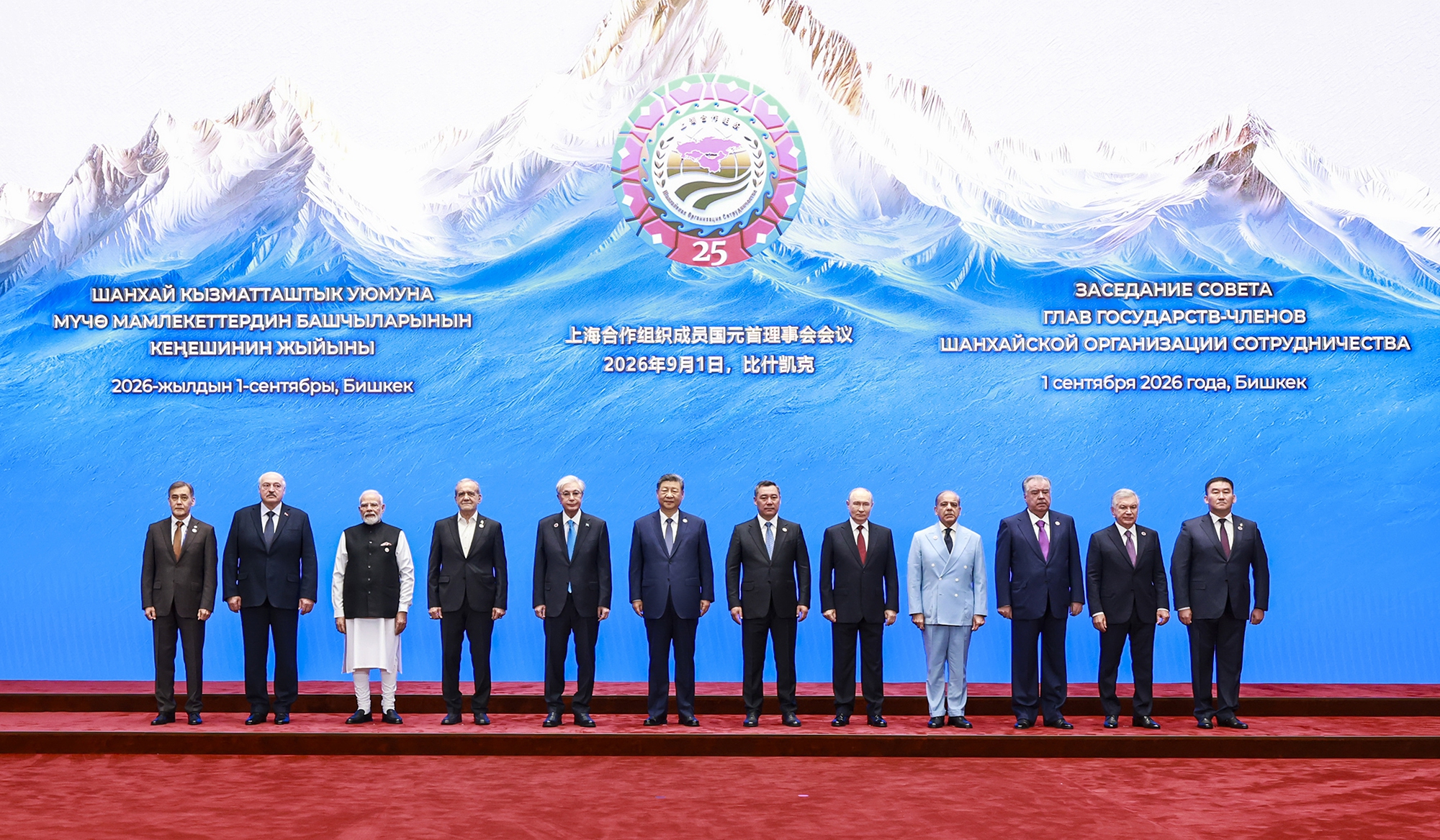
The Shanghai Cooperation Organization’s 26th summit in Bishkek ended with an expanded agenda and a sharper focus on the conflicts and security challenges shaping Eurasia.
Held on August 31 and September 1, the summit marked the SCO’s 25th anniversary and brought together leaders from its 10 member states, including China, Russia, India, Pakistan and Iran. The leaders adopted the Bishkek Declaration and 28 documents covering security, trade, energy, technology, climate and institutional cooperation.
The summit also exposed the differences within the group. While members presented a common position on sovereignty, terrorism and multilateralism, India and Pakistan again offered contrasting approaches to regional security, while the war involving Iran dominated the political backdrop.
Iran Takes Centre Stage
The conflict involving Iran was one of the summit’s most consequential issues.
The Bishkek Declaration condemned military strikes on Iranian territory, expressed support for Iran’s sovereignty and territorial integrity, and called for the conflict to be resolved through political and diplomatic means. SCO members also opposed unilateral coercive measures that they said were inconsistent with international law.
The organization also reaffirmed members’ right to pursue the peaceful use of nuclear energy under international law. For Iran, the statement offered significant diplomatic backing from a group that includes China, Russia and India.
Iranian President Masoud Pezeshkian also used the summit to call for international attention to the conflict and said Tehran was prepared to reciprocate if Washington returned to its commitments under a June interim agreement.
Terrorism Remains a Fault Line
Despite the SCO’s expanding economic agenda, counterterrorism remained central to the organization.
Indian Prime Minister Narendra Modi called terrorism a challenge to humanity and urged members to reject what he described as double standards. He called for action against terrorist financing, recruitment, radicalization and safe havens.
The remarks carried an unmistakable regional dimension given India’s longstanding tensions with Pakistan. Pakistan’s Prime Minister Shehbaz Sharif, meanwhile, emphasized his country’s own sacrifices in fighting terrorism.
The summit approved regulations for a new Universal Centre for Countering Security Challenges and Threats as well as the executive committee of the SCO Anti-Drug Centre. Members also adopted programmes on drug addiction and synthetic drugs through 2030.
Modi and Putin Meet
The summit also provided an important setting for India-Russia diplomacy.
Modi and Russian President Vladimir Putin held bilateral talks on the sidelines, discussing bilateral cooperation as well as the conflicts in Ukraine and West Asia. The meeting underscored the importance both countries continue to attach to their relationship despite India’s growing engagement with the United States and Europe.
Putin also held talks with Chinese President Xi Jinping and other leaders during the summit, reinforcing the SCO’s role as a forum for major Eurasian powers to maintain high-level diplomatic contact.
China Pushes AI and Technology
Technology emerged as one of the clearest signs of the SCO’s expanding agenda.
China proposed an international AI application cooperation centre with SCO countries and announced plans for 100 technological cooperation projects over the next three years. Beijing also proposed a China-SCO port economic cooperation centre in Tianjin.
The SCO adopted a memorandum on artificial intelligence cooperation, alongside measures covering information cooperation and digital development.
For an organization traditionally associated with security, the attention given to AI shows how technology is becoming increasingly linked to economic competitiveness, governance and national security.
Connectivity and Economic Cooperation
Economic cooperation remained another major theme.
SCO members backed deeper cooperation in trade, investment, energy and transport, while emphasizing the importance of improving regional connectivity and logistics.
The summit also advanced cooperation with other regional organizations. Leaders approved a SCO-CSTO-CIS roadmap, while the SCO moved to strengthen ties with institutions including the Eurasian Economic Commission, the UN Environment Programme and the League of Arab States.
These initiatives point toward a broader network of institutional cooperation rather than a single SCO economic bloc.
A New Focus on Climate and Energy
Climate and energy also featured prominently in the summit’s agreements.
Members adopted measures on climate cooperation, energy conservation and efficiency, and continued work on green technology.
The inclusion of these issues reflects the practical concerns facing countries across Central and South Asia, where energy security, water stress and climate-related disasters increasingly overlap with economic and national-security priorities.
Pakistan Takes the Chair
Pakistan assumed the SCO’s rotating chairmanship for 2026-27, taking over from Kyrgyzstan.
Prime Minister Shehbaz Sharif presented Pakistan’s theme as “Turning Vision into Action: Connectivity, Innovation and Shared Prosperity.” Islamabad has indicated that its priorities will include connectivity, technology and AI, energy, disaster management, health, culture and economic cooperation.
Pakistan will host the next SCO Council of Heads of State meeting in 2027.
The chairmanship gives Islamabad an opportunity to place connectivity and economic cooperation higher on the SCO agenda while navigating the organization’s internal political differences.
English Joins the SCO’s Official Languages
The summit also produced an important institutional change.
Members approved amendments to the SCO Charter that add English as an official and working language, alongside Chinese and Russian.
The change comes as the organization has expanded well beyond its original membership and now includes countries with very different political systems, languages and regional priorities.
The summit also named Lahore the SCO Tourism and Cultural Capital for 2026-27, while India announced plans to host the first SCO Civilisation Dialogue Forum later this year.
From Security Forum to Broader Eurasian Platform
The Bishkek summit showed how far the SCO’s agenda has expanded since its creation 25 years ago.
Security remains at its core, but the organization is increasingly using the same forum to discuss AI, energy, climate, transport, trade and cultural cooperation.
That expansion does not erase the differences among its members. India and Pakistan remain divided over terrorism, China and India have competing strategic interests, and members hold different positions on major international conflicts.
What the summit demonstrated, therefore, is not a unified geopolitical bloc, but a growing platform where countries with different interests can pursue cooperation where those interests overlap.
With Pakistan now holding the chairmanship, the next test will be whether the SCO can turn the agreements reached in Bishkek into practical cooperation, particularly in connectivity, technology, security and economic development.
Related stories:
What the SCO Summit Reveals About a Multipolar World
SCO Summit 2024 – Key Highlights