

Erin Brockovich, the environmental activist best known for exposing one of the most infamous corporate pollution cases in U.S. history, is now turning her attention to a new frontier: the rapid expansion of artificial intelligence infrastructure.
This time, the battleground is not industrial waste or contaminated groundwater, but the physical backbone of the AI revolution itself: data centers.
The hidden cost of the AI boom
Behind the promise of AI lies a fast-growing network of data centers, massive facilities that store, process, and train the systems powering everything from search engines to generative AI tools.
But this growth comes with significant resource demands.
Critics argue that the AI infrastructure buildout is:
- Driving surging electricity demand, often placing pressure on local power grids
- Increasing water consumption for cooling systems that must run continuously
- Expanding large industrial facilities into rural or semi-urban communities
- Moving faster than environmental review and public oversight processes
While tech companies frame data centers as essential infrastructure for innovation, critics say the environmental cost is becoming increasingly difficult to ignore.
Tracking AI’s physical footprint
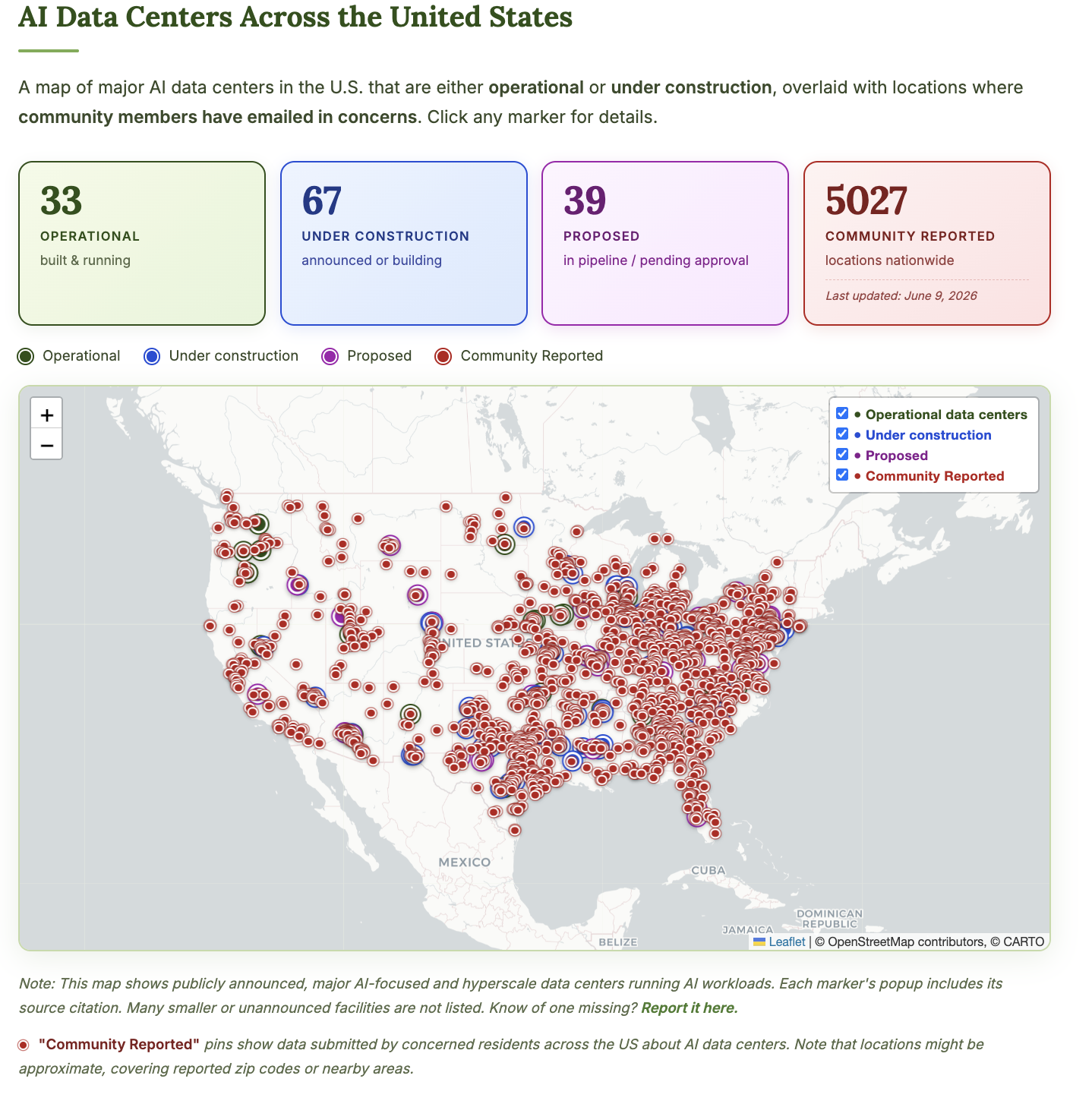
To bring visibility to this expansion, Brockovich has launched a public interactive mapping platform that tracks AI data centers across the United States.
The platform aims to document what is often an opaque development process by showing how the infrastructure of AI is spreading geographically and politically.
Key features include:
- Mapping of 4,200+ data center sites across the U.S.
- Differentiation between operational, under-construction, and proposed facilities
- A public submission system where residents can report concerns or new developments
- A visual overlay of community complaints tied to specific locations
According to the platform, it has already collected around 2,700+ public reports, highlighting concerns from residents living near existing or planned facilities.
Brockovich’s stated goal is to increase transparency in an industry that often advances faster than public awareness, allowing communities to see where development is happening before projects become irreversible.
The Rising Wave of Grassroots Accountability
As the demand for processing power skyrockets, tracking the localized fallout of data centers has rapidly evolved into a critical investigative beat. Brockovich’s map provides a stark visual representation of this boom, currently identifying 33 operational data centers, 44 actively under construction, and 27 proposed projects nationwide. The true scale of public anxiety, however, is reflected in the numbers: thousands of community reports have already flooded the platform, a figure that continues to climb as more people realize what is being built in their backyards. By giving communities a centralized platform to voice their concerns, the project is shedding light on a massive infrastructure shift that, until now, has largely been unfolding behind closed doors.
What the data center boom is built on
Data centers are now critical infrastructure for artificial intelligence, cloud computing, and digital services. But their expansion comes with significant resource demands.
Key environmental pressures highlighted by critics include:
Energy consumption: High electricity demand places pressure on local and regional power grids
Water usage: Large volumes of water are required for cooling systems operating continuously
Electronic waste: Frequent hardware upgrades generate growing volumes of e-waste
Location risks: Facilities can be vulnerable to flooding, extreme weather, and infrastructure disruption
Scalability challenges: Expansion often moves faster than local planning systems can adapt
Noise pollution: Constant cooling systems and backup generators affect nearby communities
Supporters argue these facilities are essential to economic growth and technological progress, while critics describe them as an overlooked environmental cost of the AI era.
Small Towns Fight Back
Public resistance to AI infrastructure is rapidly evolving from localized complaints into a powerful political and legal force. On the political front, grassroots backlash is reshaping local governments. In Festus, Missouri, furious voters ousted four city council members after they approved a $6 billion data center against public wishes. Meanwhile, residents in Port Washington, Wisconsin, successfully passed the nation’s first anti-data-center referendum to restrict public financing for future projects.
The legal battlefield is heating up just as quickly. Amazon recently agreed to a landmark $20.5 million class-action settlement over allegations that an Oregon data center contaminated community drinking water with nitratesa case that has put towns across the country on high alert regarding the hidden environmental risks of hosting these massive facilities.
A $156 Billion Roadblock for Big Tech in AI
This intensifying wave of community opposition is hitting tech developers where it hurts most: their timelines and bottom lines. In 2025 alone, fierce local pushback resulted in the delay or outright cancellation of an estimated $156 billion worth of data center projects. What once began as isolated, neighborhood-level protests has now consolidated into a massive national movement, highlighted by a coalition of over 200 environmental and community organizations demanding an immediate freeze on all new data center construction across the United States.
The bigger question behind the AI boom
The expansion of AI infrastructure is often presented as inevitable. But the growing visibility of its footprint is forcing a broader public debate.
At the center of it is a simple but increasingly urgent question:
As the AI revolution accelerates, who decides where its infrastructure is built — and who carries its environmental cost?
Visit the website for more information: https://www.brockovichdatacenter.com/