

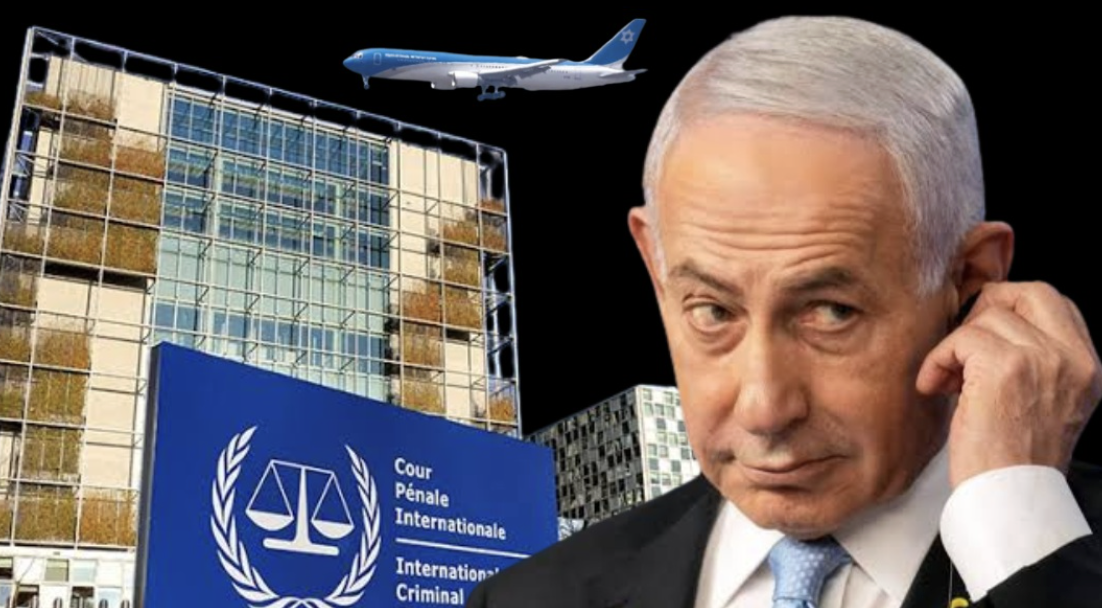
Despite an outstanding arrest warrant from the International Criminal Court (ICC), Israeli Prime Minister Benjamin Netanyahu flew through the airspace of four ICC members: Greece, Italy, France, and Canada. According to flight tracking data from February 2026, the Wing of Zion, the official aircraft of the Israeli government, passed through these nations’ airspace en route to Washington, where Netanyahu met with US President Donald Trump.
The journey has reignited discussion over the International Criminal Court’s efficacy and member nations’ readiness to fulfill their obligations under the Rome Statute. The episode has raised larger concerns about the implementation of international law when political and strategic interests are at play, even if legal experts disagree on whether an aircraft just passing through a state’s airspace implies a responsibility to take enforcement action.
Why does this matter?
The International Criminal Court lacks both an independent enforcement mechanism and a police force, in contrast to domestic courts. Rather, it completely depends on its member states to carry out arrest warrants, assist with investigations, and turn over people under its control.
It raises concerns about the Court’s ability to enforce its rulings and the degree to which states are willing to support international justice when diplomatic and geopolitical factors come into play when a leader facing an ICC arrest warrant is able to travel internationally without interruption.
What the ICC said in 2024
The International Criminal Court (ICC) issued arrest warrants for Israeli Prime Minister Benjamin Netanyahu and former Defense Minister Yoav Gallant in November 2024, citing reasonable suspicion that they were responsible for war crimes and crimes against humanity during the Gaza conflict, including the alleged use of starvation as a tactic.
One of the Court’s most important actions against the head of a close Western ally was the issuance of the warrants. Members of the ICC are obligated to assist the Court as states parties to the Rome Statute. However, experts in international law continue to disagree about the scope of those duties when an airplane carrying a wanted person simply passes through national airspace without landing.
The Significance of Netanyahu’s Flight
The International Criminal Court lacks both an independent enforcement mechanism and a police force, in contrast to domestic courts. To carry out arrest warrants and assist with legal proceedings, member nations are solely responsible.
When someone with an ICC arrest warrant is free to go abroad, concerns about the Court’s jurisdiction and states’ commitment to upholding international law are unavoidably raised.
The episode serves as an example of the political constraints of international justice for ICC supporters. Critics see it as evidence of the ongoing discrepancy between official conduct and legal obligations.
Greece
Greece has permitted repeated Israeli overflights since the warrant was issued, while maintaining closed diplomatic, military and energy security ties with Israel in the Eastern Mediterranean.
Greece’s choice illustrates the larger difficulty many countries encounter in striking a balance between international legal commitments, strategic partnerships, and regional security concerns, even though Greece is still committed to the Rome Statute.
Italy
Italy’s response was similarly logical and similarly informed by its own long standing ties with Israel. Rome‘s non objection to the over fights played into a broader debate in European capitals on whether ICC rulings are regarded as binding when they involve a close western ally rather than a more isolated one.
France
Due to its longtime support for multilateral institutions and its position as a permanent member of the UN Security Council, France’s response garnered special attention.
According to French officials, permitting the overflight was in line with France’s legal commitments. That interpretation has been contested by some international legal specialists, who contend that the case emphasizes the ongoing ambiguity surrounding the enforcement of ICC warrants in circumstances involving planes passing through national airspace.
As one of the most powerful nations in Europe, France’s stance will probably influence how other nations handle such circumstances in the future.
Canada
Canada has continuously supported international law, accountability, and the rules-based international order as key tenets of its foreign policy, having been one of the original proponents of the International Criminal Court.
As a result, the overflight has sparked a fresh discussion about whether Canada’s response is consistent with the values it has long supported globally and whether political factors are increasingly impacting the execution of international legal obligations.
What It All Means For the ICC
In each of the four cases the legal position is the same. By ratifying the Rome Statute a state commits itself to arrest anyone from whom the ICC has issued a warrant if that person enters its territory or airspace. None of the four states challenged that requirement.
That pattern is beyond this one case. Legal experts warned that the repeated and unchallenged over flights risk creating an informal precedent that other states could invoke if they choose to ignore a warrant in the future. Every warrant not enforced makes it that much easier to ignore the next. The ICC’s authority does not come from the strength of its legal text. It depends on states acting as if that text is binding, even when it is inconvenient to do so. And once that link is broken for one head of government, it is more difficult to maintain for the next.
The conflict between international law and political reality has been rekindled by Benjamin Netanyahu’s trip over the airspace of four ICC member states. The incident highlights a larger issue facing the International Criminal Court: ensuring that its rulings are applied consistently regardless of the political status of those involved, even though legal opinions are still divided on whether overflight alone creates an obligation to take enforcement action.
The case raises significant concerns about the ICC’s future legitimacy and the rules-based international order as geopolitical rivalries continue to influence international relations. Future discussions about the application of international justice will probably be influenced by whether this incident is seen as a singular occurrence or as a component of a larger pattern.
Related stories:
ICC seeks arrest warrants for top Taliban leaders in Afghanistan
Trump slams Netanyahu following US-Iran peace deal
Countries that would arrest Netanyahu