
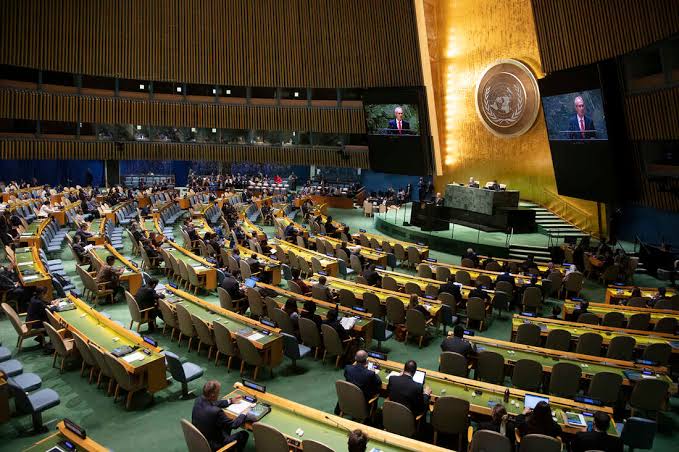
The United Nations General Assembly’s Sixth Committee has made a groundbreaking decision to move the long-anticipated Draft Crimes Against Humanity treaty to formal negotiations. This development marks a significant milestone in global efforts to address some of the most egregious crimes committed against civilians, including a strong push to codify ‘gender apartheid’ as a crime against humanity.
The decision comes after years of advocacy by human rights defenders, legal experts, and civil society groups. In particular, the ‘End Gender Apartheid Campaign’, launched in March 2023 by Afghan and Iranian activists alongside international jurists, has called for recognizing gender apartheid within international law.
This decision marks a pivotal moment in global efforts to address egregious offenses such as murder, rape, torture, and other widespread atrocities committed against civilians by governments or organizations. Although the committee typically operates by consensus, the vote is expected to proceed due to opposition from Russia, which has voiced its concerns over the proposed treaty.
A Crucial Step Forward for International Law
The push for a comprehensive international legal framework to tackle crimes against humanity has been long overdue. Unlike genocide, war crimes, and other serious violations, there is no standalone treaty dedicated to these heinous offenses. Crimes against humanity encompass widespread acts such as murder, rape, forced displacement, and torture, committed as part of a government or organization’s policy. Despite being incorporated into the Rome Statute of the International Criminal Court (ICC), these offenses have not yet been codified in a binding international treaty.
Human Rights Watch has been vocal about the need for such a treaty, arguing that without it, the international community lacks a unified legal approach to preventing and prosecuting these crimes. “The lack of a treaty leaves a stark gap in protecting civilians clearly at risk,” said Richard Dicker, senior legal adviser at Human Rights Watch. The ongoing atrocities in regions like Ethiopia, Ukraine, Sudan, Myanmar, and the occupied Palestinian territories have highlighted the urgent need for a treaty to address crimes against humanity.
Global Support for the Treaty
The draft resolution, which now moves to formal negotiations, has garnered significant support from a broad coalition of countries. The resolution, co-sponsored by 94 UN member states, represents a diverse cross-regional group, with strong backing from countries in the Americas, Africa, Europe, Asia, and the Middle East. Notably, Mexico and The Gambia have taken leadership roles in advocating for the treaty.
The treaty’s goal is clear: to establish a formal mechanism that obligates UN member states to cooperate in preventing and punishing crimes against humanity. The resolution also sets a definitive timeline for the treaty’s negotiation process, with a diplomatic conference scheduled for early 2027 to begin discussions, and a second session in 2028 to finalize the treaty text.
Recognizing Gender Apartheid
One of the key elements under discussion is the inclusion of ‘gender apartheid’ —a term that captures the systematic oppression of women and girls under regimes such as the Taliban in Afghanistan. During the negotiations, the Afghan delegation, representing the recognized government, described the institutionalized denial of education and employment opportunities for women as a targeted assault on Afghan society.
Metra Mehran, a policy advisor with the End Gender Apartheid Campaign, highlighted the importance of this development:
“Seeing the Crimes Against Humanity treaty move forward gave me a glimmer of hope to keep resisting. Everything feels so grim under Taliban atrocities, but knowing there’s a process with capacity to acknowledge our pain and name these atrocities helps us heal and keep going.”
This sentiment is shared by other survivors and human rights defenders who see this treaty as a tool to achieve justice and accountability for victims of systemic gender-based oppression.
A Treaty with Global Relevance
Legal experts believe this treaty could close significant gaps in international law and ensure stronger protections for victims of atrocities. Akila Radhakrishnan, a legal advisor for the End Gender Apartheid Campaign, stressed its importance:
“A new treaty isn’t just an abstract legal exercise; it is an important tool to protect victims and survivors. It offers an opportunity to address gaps in international law, fix previous compromises, and add emerging gender crimes like gender apartheid.”
The inclusion of gender-based violence and other emerging crimes could provide much-needed accountability for perpetrators who continue to operate with impunity.
A Decade-Long Advocacy Effort
The decision by the Sixth Committee reflects over a decade of advocacy for stronger international mechanisms to combat crimes against humanity. Gissou Nia, another legal advisor for the campaign, emphasized the treaty’s relevance to diverse victim communities:
“This move gives a much-needed boost to victims in search of justice. From the displaced Rohingya child to the silenced Afghan woman, this treaty could prevent and punish atrocities globally. Governments and civil society must now push for a strong final text.”
The treaty also seeks to address systemic abuses such as forced marriage, reproductive violence, and the enslavement of women and girls—crimes that have often gone unpunished in conflict zones.
Russia’s Opposition and the Path Forward
Despite the widespread support for the treaty, Russia has expressed opposition, which has led to the expected vote on the matter. Moscow’s refusal to back the resolution stems from concerns over the broad scope of the treaty and its potential implications. Human Rights Watch has called for UN members to stand firm and reject any attempts to obstruct progress, emphasizing the importance of moving forward with negotiations.
“If Russia insists on a vote and obstructs progress, other countries must ensure this tactic fails,” said Dicker. The UN’s decision to move the treaty forward, despite opposition, underscores the determination to strengthen international law and protect civilians worldwide from mass atrocities.
What Will be the Role of UN Member States in Shaping the Final Treaty?
As the treaty progresses to negotiations, it will be critical for UN member states to adopt a progressive, gender-competent approach that ensures the inclusion of key provisions, such as those addressing gender-based violence and atrocities committed against vulnerable groups. The draft treaty must not only reflect evolving definitions under customary international law but also ensure that justice is served for victims of these grave crimes. The international community must remain committed to finalizing a treaty that provides real protection and accountability.
The question remains: Will the international community remain unified in its pursuit of this essential treaty, or will geopolitical divisions continue to hinder meaningful progress? The upcoming negotiations will reveal the path forward.
Related Stories:
Defining gender apartheid : Malala calls for justice in Afghanistan
Members of European Parliament Demand Global Accountability for Gender Apartheid
France Welcomes Afghan Women Escaping Taliban’s Gender Apartheid