
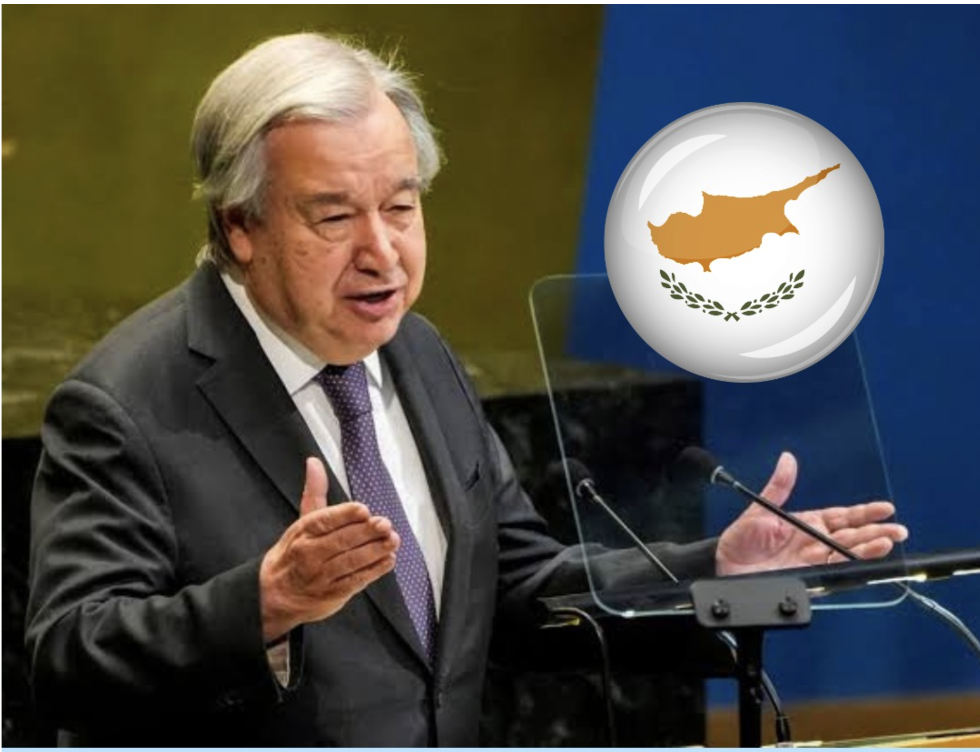
As Guterres lands in Cyprus for the first time in 16 years, a leaked framework reveals how far the UN may be willing to bend the bizonal federation model, and why it’s already dividing both communities.
Observer Diplomat Context
Why This Matters
The Cyprus conflict has remained unresolved for more than five decades, making it one of the world’s longest-running territorial disputes and Europe’s last major divided capital. While the island joined the European Union in 2004, it remains split between the internationally recognized Republic of Cyprus in the south and the Turkish-controlled north, recognized only by Turkey.
The renewed diplomatic activity comes at a particularly significant moment. With António Guterres approaching the end of his tenure as UN Secretary-General, international mediators are attempting to determine whether meaningful negotiations can still be revived after years of deadlock. At the same time, evolving EU–Turkey relations, regional security concerns in the Eastern Mediterranean, and renewed international engagement have elevated Cyprus back onto the geopolitical agenda.
Although no official UN settlement proposal has been presented, reports of an informal framework under discussion have sparked debate across both communities. Whether these discussions evolve into formal negotiations or become another failed diplomatic initiative will likely shape the future of the island for years to come.
Cyprus Conflict: At a Glance
1974 — Following a Greek-backed coup, Turkey invaded Cyprus, leading to the island’s de facto partition.
1983 — The Turkish Republic of Northern Cyprus (TRNC) declares independence, but it is recognized only by Turkey.
2004 — The UN-backed Annan Plan for reunification is accepted by Turkish Cypriots but rejected by Greek Cypriots. Cyprus joins the European Union as a divided island.
2017 — Peace negotiations at Crans-Montana collapse without an agreement.
2026 — Guterres launches a renewed diplomatic initiative amid reports of a possible new negotiating framework and growing international engagement.
About the Author
Stelios Elia
BSc in Turkish Studies, M.A. in European Governance
Stelios Elia is a political and media officer with nearly a decade of experience in Cyprus-focused diplomacy, having served at an embassy in Nicosia monitoring media, drafting political analysis, and coordinating with Cypriot government officials. He previously worked at the Embassy of Cyprus in Washington D.C. on EU-U.S. relations and foreign affairs.
Diplomatic Activity Around the Cyprus Problem Has Intensified
Diplomatic activity around the Cyprus problem has accelerated sharply in recent weeks, culminating in the upcoming visit of UN Secretary-General António Guterres — the first such visit in sixteen years. His arrival follows a series of leaks suggesting that the UN is exploring a more flexible, transitional approach to the process, signalling that the long-stalled negotiations may be entering a new phase.
During his visit later this month (27–29 July), Guterres will meet President Nikos Christodoulides and Turkish Cypriot leader Tufan Erhürman separately before bringing them together for a joint session aimed at assessing common ground, setting timelines, and shaping the parameters of any subsequent process. Analysts note that the UN’s objective is to build momentum toward substantive negotiations and prepare the ground for a possible five-party conference in September involving the two sides and the guarantor powers.
The Secretary-General’s decision to come to Cyprus carries both symbolic and substantive weight. It reflects the importance he personally — and the UN institutionally — attach to the current diplomatic moment. With only months remaining in his term, Guterres appears determined to test whether conditions exist to place the process back on a credible path to resolution, with the immediate goal of convening a results-oriented informal conference.
A key question is whether he will arrive with a concrete proposal or any kind of outline of a settlement framework. Beyond leader-level diplomacy, he also intends to meet civil-society actors on both sides to encourage broader societal involvement. The Secretary-General’s visit follows intensive groundwork by his Personal Envoy, María Holguín, who has conducted consultations in Cyprus, Athens, Ankara, and Brussels to prepare the terrain for this renewed effort.
EU–Turkey Rapprochement and the Cyprus Link
Guterres arrives at a moment of full synchronisation between the UN and the EU, with both actors investing heavily in the broader framework of EU-Turkey relations. Brussels has intensified its diplomatic engagement, maintaining direct channels with Turkish President Erdoğan and his team on issues linked to the Cyprus process. A key development was the appointment of Executive Vice-President Raffaele Fitto as the European Commission’s Special Representative for Cyprus, with a mandate to work closely with Holguín.
This alignment strengthens the political linkage advanced by Nicosia: that meaningful progress in EU-Turkey relations can occur only if Turkey delivers tangible developments on Cyprus and fulfils its obligations. In theory, this conditionality enhances Cyprus’ negotiating leverage. The recent appointments and intensified contacts form essential pieces of the diplomatic puzzle that has taken shape in recent weeks.
The Independent Leak: A Radical Conceptual Framework
Against this backdrop, a recent leak in British newspaper The Independent described what appears to be a radically different conceptual framework under informal consideration within UN circles. The model reportedly centres on “recognition in exchange for territory,” built around two constituent states and a highly decentralised central government with minimal shared competences. Each side could label the arrangement differently: the Greek Cypriots can present it as “federation” while the Turkish Cypriots present it as “confederation.” There seems to be an effort to rely on constructive ambiguity to bridge definitional gaps.
The outline includes a presidential council within a loose federal architecture, extensive territorial adjustments, and a security arrangement potentially linked to NATO. Sovereignty would flow from the two states to the centre — an unprecedentedly loose model compared to the long-standing bizonal bicommunal federation.
The leak is widely interpreted as a “sounding,” a deliberate test of public and political reactions rather than a formal proposal. Cypriot officials in London have publicly cautioned that the ideas circulating are speculative rather than a concrete plan. President Christodoulides had already hinted since May at the possibility of a solution plan emerging before the end of 2026, and did not exclude a major conference before Guterres’ term ends, adding context to the timing of the publication.
Signals from Ankara and the Positions of the Two Sides
Additional signals have emerged from Ankara. President Erdoğan’s decision not to attend the 20 July anniversary events in the north for the 1974 invasion was interpreted by Turkish and Turkish Cypriot sources as a goodwill gesture linked to Guterres’ visit and the messages he may bring. Yet Ankara’s position remains firm: representing Turkey at the celebrations in the north, Turkish Vice-President Cevdet Yılmaz reiterated support for a two-state settlement.
The positions of the two communities remain clear. Turkish Cypriots seek meaningful participation in common institutions and decision-making, rejecting any arrangement that assigns them minority status. Greek Cypriots accept the effective participation of the other side, but without permanent paralysis, alongside implementable arrangements on territory, property, settlers, and refugee return. Crucially, for the Greek Cypriot side, any acceptable agreement must include the termination of unilateral intervention rights and a binding timetable for troop withdrawal.
It is important to note that no official UN plan has been submitted, and the UN’s institutional basis has not changed. The Security Council continues to support a bizonal, bicommunal federation with political equality. Yet even before any official text exists, denunciations have already begun. On the Greek Cypriot side, reports and analyses have surfaced accusing the emerging ideas of constituting a “Turkish plan,” a “sell-out,” or even “treason,” illustrating the sensitivity of the moment. From the Turkish Cypriot side, officials of the unrecognised Turkish Republic of Northern Cyprus (TRNC — a de facto entity recognised only by Turkey) have pushed back with statements insisting on a two-state solution and arguing that no results can be achieved through negotiations within Cyprus, asserting that “any partnership with the Greek Cypriots is no longer in question.”
A New Diplomatic Landscape
Taken together, these developments reflect a shifting diplomatic landscape and a clear intensification of international engagement. The convergence of UN and EU efforts, the signals from Ankara, the groundwork laid by Holguín, and the exploratory leak in The Independent all point to a renewed push to test whether conditions now exist for meaningful progress.
As many observers have noted, the current diplomatic mobilisation may well represent a final opportunity to avert the island’s definitive partition. Cypriots on both sides must recognise that the de-facto situation cannot evolve into a sustainable or legitimate settlement, and that failure to engage constructively now risks locking in an irreversible reality. The stakes of this moment are therefore exceptionally high: either the process moves forward, or the prospect of reunification may disappear altogether.
Observer Diplomat Analysis
The language doing the most work here is “constructive ambiguity” — letting Greek Cypriots call the arrangement a federation and Turkish Cypriots call it a confederation. That trick has papered over Cyprus talks before, but it has never actually produced a settlement; the 2004 Annan Plan and the 2017 Crans-Montana talks both collapsed once the ambiguity had to resolve into specifics. The real test isn’t whether both sides can agree on a word — it’s whether “sovereignty flowing from the two states to the centre” survives contact with the details: how minimal is “minimal shared competences,” and who controls security once a NATO-linked arrangement replaces the 1960 guarantee system. Cyprus itself isn’t a NATO member, while Turkey and Greece are — a structural asymmetry that any security formula will have to resolve, and one that’s likely to become a flashpoint the moment specifics are put on paper.
The bigger question is timing pressure. Guterres has months left in his term and reportedly wants a legacy outcome; Christodoulides has floated a 2026 timeline. That kind of deadline-driven diplomacy can force genuine breakthroughs — but it can also produce a rushed framework that neither side has fully bought into, which is exactly how past Cyprus initiatives have failed. Whether this becomes the moment the process finally moves, or another blueprint that dies in the details, will likely become clear well before any formal five-party conference convenes.
What to Watch
- 27–29 July — Guterres visits Cyprus, holds separate meetings with Christodoulides and Erhürman, then a joint/trilateral session
- Ongoing — Holguín’s shuttle diplomacy across Nicosia, Athens, Ankara, and Brussels, working alongside newly appointed EU Special Representative Raffaele Fitto
- Late August–September — Possible five-party conference (both sides plus guarantor powers Greece, Turkey, and the UK), potentially timed around the UN General Assembly in New York
- Through 2026 — Christodoulides has not ruled out a settlement framework emerging before year’s end
Context: Federation vs. Confederation, Explained
The fight over this one word isn’t semantic — it determines where power actually sits.
Federation (the UN’s official basis since the 1970s) means sovereignty starts at the center. A single Cypriot state exists first, and it delegates specific powers down to two constituent units — Greek Cypriot and Turkish Cypriot. The center is the source of authority; the states are its components.
Confederation flips that. Sovereignty starts with the two states, and they voluntarily transfer a limited set of powers to a shared central authority while retaining primary sovereignty. The states remain the source of authority, while the central institutions exercise only those powers delegated to them.
The leaked framework tries to let each side call it what it wants: Greek Cypriots can describe it as a federation, Turkish Cypriots as a confederation, because the underlying design — “minimal shared competences,” sovereignty explicitly flowing from the states to the centre — technically supports both readings. That’s the “constructive ambiguity” at the heart of the plan.
But the distinction has teeth. A confederation implies each constituent state could, in principle, exist independently — which is precisely why Greek Cypriots have historically rejected the term, seeing it as a disguised path to partition. A federation implies the state’s unity is non-negotiable — which is precisely why Turkish Cypriots have pushed back on it, seeing it as a framework that permanently subordinates them within a Greek Cypriot–dominated system. The UN Security Council’s official position still calls for a “bizonal, bicommunal federation” — meaning this leaked model, if real, would represent one of the loosest structures ever seriously floated within that mandate.
Related stories:
UN Secretary-General António Guterres on Palestine Day.
World ‘paying price’ for climate inaction, UN’s Guterres warns
The meeting between President Xi Jinping and UN Secretary-General António Guterres