

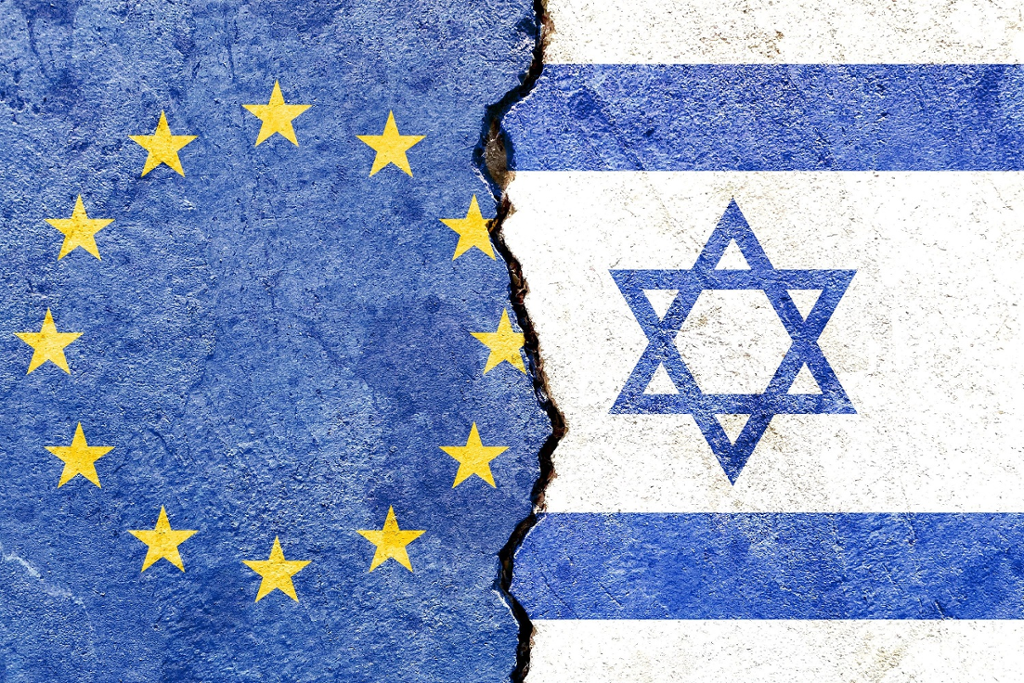
Deep disagreements over international law, human rights, and the future of EU-Israel relations were revealed when Germany and Italy were the only EU members to publicly oppose the suspension of the Association Agreement with Israel due to the war in Gaza.
Despite growing calls from several member states to review the bloc’s relationship with Israel in light of the ongoing conflict in Gaza, the European Union has once again found itself divided over its policy toward Israel after Germany and Italy blocked attempts to suspend the EU-Israel Association Agreement.
Spain, Ireland, and Slovenia pressed for the agreement’s suspension during a meeting of EU foreign ministers in Luxembourg, claiming that Israel’s military campaign in Gaza is incompatible with the treaty’s human rights commitments. Nevertheless, the idea was rejected by Germany and Italy, which prevented the European Union from coming to the necessary political agreement to proceed.
The dispute has brought to light a widening gap between European nations that support ongoing diplomatic relations with Israel and those who prioritize responsibility under international law.
Why the Agreement Matters
The legal foundation for political communication and economic collaboration between the European Union and Israel is the EU-Israel Association Agreement, which came into effect in 2000. Trade, scientific research, technology, investment, education, and cultural interactions are all governed by it.
With bilateral commerce topping €45 billion in 2025, the European Union is Israel’s biggest commercial partner. As such, the agreement is one of the most important cornerstones of Israel’s international economic ties.
The European Union’s toughest diplomatic action against Israel since the start of the Gaza War would have been to suspend the pact.

Germany and Italy Blocked the Proposal
Germany and Italy were the only members to openly reject the measure, while Slovenia, Spain, and Ireland suggested that the deal should be halted.
Johann Wadephul, the Foreign Minister of Germany, maintained that diplomatic engagement is still the most effective way to influence Israeli policy and that continuing communication with Israel is more effective than halting institutional cooperation. Italy took a similar stance, prioritizing ongoing political participation over punitive actions.
Berlin and Rome continue to have a major effect on the bloc’s foreign policy decisions, as evidenced by their opposition, which finally stopped the European Union from moving forward with the idea.
A number of things influenced their position. Both Germany and Italy have strong economic, scientific, and security ties with Israel, and Germany has a long-standing political commitment to Israel based on its historical duty after the Holocaust. Their foreign policy decisions are still heavily influenced by these strategic goals.
Article 2 at the Core of the Discussion
Proponents of suspension contend that the problem goes beyond politics and involves the legal responsibilities of the European Union.
According to Article 2 of the EU-Israel Association Agreement, respect for democratic values and human rights is the cornerstone of both sides’ relationship. Spain and its allies argue that the agreement should be suspended since Israel’s activities in Gaza violate this article.
Pedro Sánchez, the prime minister of Spain, has frequently maintained that if the agreement’s human rights requirements are no longer being upheld, the European Union cannot legitimately claim to be a defender of international law while carrying on with business as usual.
Israel maintains that its military actions are carried out in self-defense in response to Hamas’ strikes on October 7, 2023, and denies accusations that it has broken international law.
An Evaluation of the Credibility of the European Union
A more general question concerning the European Union’s credibility with regard to international law and human rights has emerged from the discussion surrounding the pact.
The EU has regularly called for accountability in international disputes and has continuously positioned itself as a global champion of the rules-based international order. Opponents contend that inaction against Israel in the face of growing humanitarian concerns runs the risk of giving the impression that international law is being applied selectively.
Following the International Criminal Court’s 2024 arrest warrants for Israeli Prime Minister Benjamin Netanyahu and former Defense Minister Yoav Gallant on charges of war crimes and crimes against humanity, the dispute has grown more heated. Israel denies the Court’s jurisdiction as well as the accusations.
Many observers view the dispute over the Association Agreement as a litmus test for the European Union’s willingness to implement its legal principles uniformly, irrespective of the nation in question.
Why Suspension Is Still Not Likely
The pact is unlikely to be suspended in the immediate future, despite mounting political pressure.
High Representative of the EU on Foreign and Security Policy Kaja Kallas admitted that the European Union is still split, making a suspension agreement unachievable.
Israel continues to be an important European partner in trade, innovation, cybersecurity, scientific research, and regional security despite political differences. Many nations are still hesitant to embrace policies that have the potential to drastically change relations because of these strategic interests.
Significant revisions to the accord are still unlikely in the absence of majority political support among member states.
The Greater Picture
A larger conflict over the course of European foreign policy is reflected in the disagreement over the EU-Israel Association Agreement.
For one set of member nations, the European Union’s reputation as an advocate of international law depends on the enforcement of the agreement’s human rights article. Germany and Italy continue to favor maintaining diplomatic relations and strategic collaboration with Israel.
Berlin and Rome guaranteed the agreement’s continued validity by obstructing the plan. However, the discussion has revealed one of the EU’s most profound differences in foreign policy in recent years and brought up challenging issues regarding the bloc’s ability to strike a balance between its commitment to human rights and its strategic interests.
For more information: https://citizens-initiative.europa.eu/initiatives/details/2025/000005_en
Related stories:
Germany Emerges as Top Destination for Israelis Relocating Abroad
Pentagon flags Israel as critical counterintelligence threat
51 countries sponsoring Israel’s genocide
YouTube Deletes Palestinian Rights Channels, Erasing Key Evidence of Israeli Abuses