
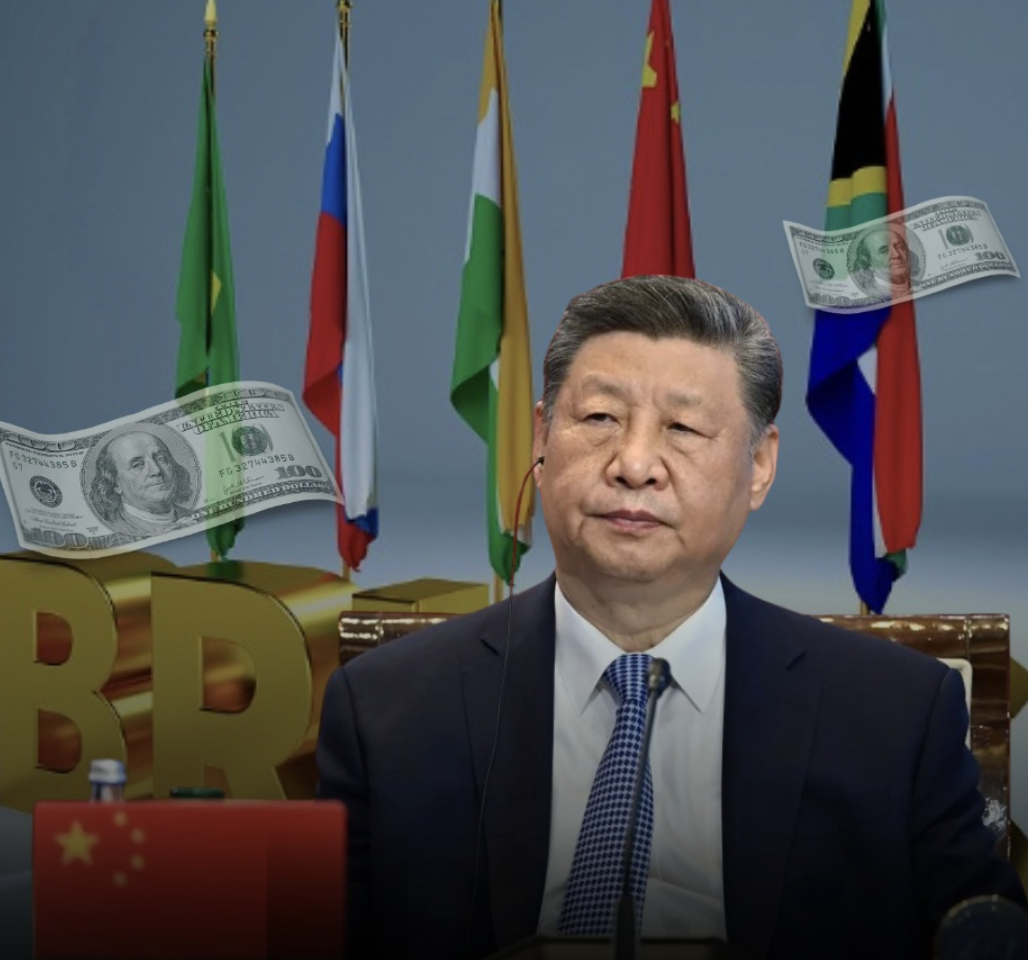
At the 15th BRICS Summit held virtually in September 2025, Chinese President Xi Jinping urged member states to “accelerate cooperation in financial innovation, payment systems, and local-currency settlements,” signalling Beijing’s ambition to advance a BRICS digital currency framework that could one day rival, or even replace, the U.S. dollar.
“The world is undergoing changes unseen in a century,” Xi said in his keynote speech. “Hegemonism, unilateralism and protectionism are getting more and more rampant. BRICS countries should jointly defend multilateralism and build a community with a shared future for humanity.”
— Xi Jinping, 15th BRICS Summit, September 8, 2025
(Source: Ministry of Foreign Affairs of the People’s Republic of China, FMPRC.gov.cn)
Although Xi stopped short of announcing a single digital currency, his emphasis on “financial sovereignty” and “payment system innovation” reflects a coordinated push by BRICS nations to reduce dependence on the U.S. dollar and Western-controlled systems like SWIFT.
Background and Context
The BRICS bloc—Brazil, Russia, India, China, and South Africa—has expanded to include Egypt, Iran, Ethiopia, the UAE, and Indonesia. The coalition’s long-term agenda increasingly focuses on building alternatives to Western-dominated institutions and establishing a multipolar economic order.
According to the Council on Foreign Relations, one of BRICS’ major goals is to “reduce reliance on the U.S. dollar through alternative payment and settlement systems.”
China’s motivation is both strategic and ideological. Facing potential sanctions and dollar-system vulnerabilities, Beijing has consistently sought to internationalize the renminbi (RMB) while advocating for a multipolar world order.
What BRICS Is Building
The BRICS nations are currently developing BRICS Pay, an interoperable payment system designed to enable cross-border settlements in member-state currencies.
However, there is no official BRICS digital currency yet.
Reuters reported in January 2025 that “the BRICS grouping is not planning a common currency, though it continues to explore ways to settle trade without using the U.S. dollar.”
Rather than a single token or coin, experts note that BRICS is pursuing a three-tiered approach:
-
Cross-border payment infrastructure (BRICS Pay)
-
Interoperability among national CBDCs (Central Bank Digital Currencies)
-
Increased use of local currencies in bilateral trade
Why It Matters
For Beijing and Moscow, the drive for financial independence is both symbolic and strategic. The U.S. dollar’s dominance gives Washington outsized influence over international finance. By establishing independent systems, BRICS members aim to insulate themselves from Western sanctions and promote a new architecture of trade.
“A BRICS currency would require major political compromises … The dollar remains used in more than 80 percent of global trade,” notes the Council on Foreign Relations.
— Delhi Policy Group, “China Monitor — September 2025.”
Even within BRICS, there are differences of approach. India, for instance, remains cautious about monetary integration and capital-account liberalization, preferring gradual reform to full dollar substitution.
Realistic Timeline
Analysts agree that de-dollarization will be a slow, evolutionary process rather than an abrupt shift.
| Challenge | Impact |
|---|---|
| Convertibility, trust, and liquidity | A global currency requires deep and liquid markets, something BRICS members currently lack. |
| Divergent national interests | Political and economic disparities among members slow unified action. |
| Entrenched dollar dominance | The dollar’s network effect in trade, finance, and reserves remains unmatched. |
Despite these challenges, the technological foundation, CBDCs, blockchain platforms, and digital payment rails, is gradually making alternative settlements more feasible.
President Xi’s remarks at the 2025 BRICS Summit reflect China’s long-term strategic vision: a multipolar financial system that challenges U.S. monetary hegemony.
While no official BRICS digital currency has been launched, the infrastructure, rhetoric, and political will are aligning to create the foundations of a future non-dollar global economy.
The dollar’s dominance remains intact for now—but for the first time in decades, a credible, coordinated challenge is being built, step by step, under BRICS leadership.
Related stories:
BRICS Must Resolve India-Pakistan Tensions to Protect Its Credibility
Brazil Plans To Reject BRICS Currency
Which Two BRICS Nations Officially Agree To Ditch the US Dollar For Trade?