

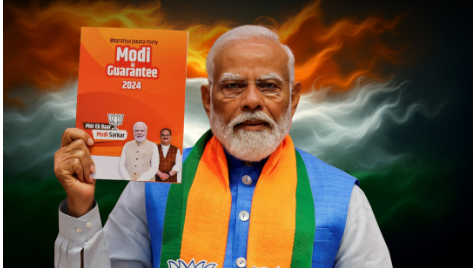
The Indian Republic was founded on a bold presumption, that a multi-ethnic, multi-religious nation could not just exist, but thrive under a secular, democratic framework. This vision, championed by Jawaharlal Nehru and protected (however imperfectly) by the Congress for decades, is now fraying. And while critics point to the Bharatiya Janata Party’s (BJP) rise as the cause, perhaps it is more accurate, and more damning, to view it as the consequence.
The BJP understood what the Congress failed to grasp: that India had never fully digested the idea of
secularism. Secularism had been inherited, not chosen. It was, in many ways, a Nehruvian abstraction, a
postcolonial answer to a trauma-ridden partition, rather than a deeply rooted societal value. Over the
decades, secularism became synonymous with elitism, capitalism and the moralistic preachings from a
political class increasingly disconnected from the average Hindu voter’s sense of belonging and historical
resentment. In contrast, the BJP offered something visceral and tangible: identity, pride, grievance, and a
promise to restore the dignity of an extremist Hindu majority who felt cheated in their own land.

A Nation Rewritten
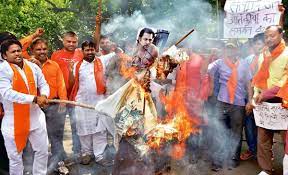
The BJP’s rise to power in the mid-1990s was initially viewed as a temporary phenomenon, something like the failed Janata experiment of the late 1970s. It was believed that once the Hindu right was handed the reins of power, their own contradictions — communal excesses, political inexperience, and the strain of governance, would undo them. It was a grave error of judgement.
The BJP is not just another right-wing outfit grasping at power through noisy rhetoric. It was, and remains,
a meticulously organized movement, with ideological clarity, organizational discipline, and a deep emotional appeal to the majority’s sense of historical grievance. Unlike Pakistan’s Zia-ul-Haq, whose Islamization campaign was often dismissed as cynical statecraft — BJP leaders meant every word they uttered about Hindu Rashtra. For them, Hindutva was not a political ploy. It was the project.
Since then, the BJP has not only endured; it has thrived. Its journey from the margins to dominance has
reshaped India’s national identity, economic priorities, and global posture. And its success has exposed
something uncomfortable: that the secular consensus in post-independence India was more brittle,
more imposed, and more vulnerable than most believed. Their method was neither accidental nor
improvised. The BJP fused economic liberalism with cultural conservatism, making “India Shining” more
than a slogan, it was a new mythology. Gone was the defensive third-worldism of the Cold War era.
In its place emerged a resurgent India, pitching itself as a tech-savvy democracy, open for business, proud of
its heritage, and unafraid of asserting its majoritarian ethos. Global corporations were courted; diaspora
pride was nurtured; the world was invited to invest, not just in Indian markets, but in a new, unapologetic India. India was not only reshaping its self-image at home, it was now amplifying its diplomatic voice abroad.
One of BJP’s earliest diplomatic coups came in March 2000, when Prime Minister Vajpayee and U.S. President Bill Clinton issued a joint statement on Indo-U.S. cooperation. The subtext was clear: India and
America were “natural allies” in democracy — “unlike Pakistan”, where a military coup had recently elevated General Pervez Musharraf. The symbolism was profound. India had long been bracketed with Pakistan in Western imaginations. Now, it was being reframed as a counterweight to its neighbor — a “stable, secular” (ironically) democracy, worthy of investment and trust.
That shift came with consequences. For Pakistan, it marked the beginning of diplomatic isolation, particularly on Kashmir. For India, it signaled that the global order would overlook communal tensions in the subcontinent, so long as economic reforms were favorable and strategic alignments remained intact.
The Performance of Power
At home, the BJP got extraordinary political space. Congress governments had parroted secular slogans on
the international fora, while quietly suppressing minority rights- as evidently illustrated by the sterilization campaign conducted by Sanjay Gandhi in the 1970s. BJP’s approach was more direct: Muslims would no
longer occupy symbolic or actual positions of power, and their historical legacy would be erased from the
national narrative. This was not just about winning elections. It was about rewriting India’s history and redefining its identity.
 Mosques, monuments, street names, even chapters in textbooks, all became targets. The demolition of the Babri Masjid in 1992 was not an anomaly but a prelude. It signaled to millions that the Hindu right was no longer on the defensive. It was on the march.
The RSS, founded in 1925, had always been suspicious of Nehruvian secularism and desired the introduction of ironclad and iron fisted Hindu nationalism into India’s social fabric: a nationalism that could arrest India’s move toward secularism. The RSS rejected both Gandhian non-violence and Congress pluralism. Its worldview, once dismissed as fringe, has now become mainstream. Underneath all this was a deeper recalibration of history. BJP-aligned thinkers often drew on centuries of real or imagined Muslim domination — from the “Mughal machinations” to colonial-era compromises — as a justification for redressal.
It was in Gujarat that one of these “redressals” took form — not as a policy, but as a purge. After the 2002
Sabarmati Express fire — the origins of which remain disputed — Hindu mobs, armed and coordinated, descended upon Muslim neighborhoods. Electoral rolls were used to identify homes. Police stood by as
mobs moved with surgical precision. The violence was not just vengeful — it was demonstrative. Luke
Harding, reporting for The Guardian, described returning to Naroda Patiya to find “a ruin of abandoned
homes and smoldering rickshaws,” and a woman’s charred body laid out in the garden of what had once
been her family bungalow. Her mobile phone rang beside her remains, just 60 meters from a police station.
“The police had not, it was obvious, bothered to rescue her”, Harding concluded.
These were not the chaotic horrors of a failed state; they were the ritualistic cruelties of an extremist ideology willing to dehumanize its citizens to sanctify a narrative. This was not chaos — it was choreography. According to the Concerned Citizens’ Tribunal, women were not only gang-raped but mutilated and burned, their bodies quartered to erase evidence. The Tribunal wrote: “Rape was used as an instrument for the subjugation and humiliation of a community”. What Gujarat revealed was not just the BJP’s ruthlessness, but the electorate’s readiness.
Months later, Modi was re-elected in a landslide! The riots had not damaged his legitimacy — they had forged it. The violence had done what ideology alone could not: it proved that a Hindu Rashtra was no longer a fringe fantasy. It could be a ballot-test. It could deliver results!
And here, again, lies a bitter irony. The very arguments used by the Quaid-e-Azam to create Pakistan — that
Hindus and Muslims were two separate nations due to inherently incompatible values — are being vindicated not by Pakistan, but by India itself. As the BJP works to forge a Hindu Rashtra, Jinnah’s view of Two Nations, long abandoned by many Muslims themselves, is now being fulfilled by his ideological opponents.
Erasing the Other
This vision of unity, however, comes at a price. For all the talk of inclusivity and development, the reality is
that BJP’s India is one of silence, erasure, and fear. Muslims, once visible in public life — as artists, politicians, actors, athletes — are increasingly invisible, or only present as caricatures in political discourse:
“infiltrators,” “anti-nationals,” “vote banks”. The Citizen Amendment Act (CAA), the proposed NRC, the
spectacle of bulldozers demolishing Muslim homes in the name of justice — all reinforce a message of
exclusion. And it’s not only Muslims. Dissenters of all stripes — students, activists, journalists — have
found themselves in jails, or worse.
Yet the BJP remains wildly popular. The Congress, for its part, has struggled to forge a meaningful opposition. Its failures were not merely strategic — they were existential. For decades, Congress wielded secularism as both shield and sword, yet presided over the steady decline of Muslim representation in the military, bureaucracy, and legislature. The Indian Union Muslim League, the successor of All-India Muslim League, was reduced to irrelevance on Congress’s watch. Congress’s brand of secularism demanded that Muslims be politically invisible while symbolically conspicuous . It created the very resentment that the BJP now so expertly channels.
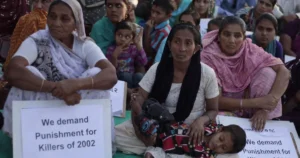 In Gujarat, the crucible of Narendra Modi’s rise, the 2002 riots became a national litmus test — one that he
passed with flying colours. Since then, Modi has reinvented himself as a global statesman and economic reformer, while never fully distancing himself from the core RSS vision. He doesn’t need to. The India
he governs has changed. It is more self-assured, more majoritarian, more nationalistic — and more willing to
overlook or even embrace the exclusion of the “other” if it means progress, pride, and power.
So what then is left of the idea of India? The Constitution still exists. Elections are still held. Newspapers are still printed and people can still post on social media — albeit under strict censorship. But the soul of the republic is missing. The “Bharati Tiranga” is hardly a tapestry of different colours anymore; it is a flag dominated by a single color, with others fading into the background. The democratic rituals remain, but the moral architecture that upheld them — pluralism, secularism, mutual respect — has been dismantled by the BJP.
And that, perhaps, is the BJP’s most enduring success: not simply winning elections, but redefining what it
means to be Indian.
If the Congress era was marked by a hypocritical brand of secularism that failed to deliver real equity, the
BJP era is one of confident majoritarianism, where power speaks plainly and pride overshadows pluralism.
The Congress marginalized minorities while pretending to protect them. The BJP erases them, while daring
anyone to protest. As Arundhati Roy argued in 2002: the Congress and BJP are the reverse and obverse of
the same coin. “Congress does under cover of darkness, what BJP does in broad daylight.”
The tragedy is that both paths have led to the same destination. And so we are left with a daunting question:
Can a nation built on exclusion ever find peace? Or will it always need new enemies to keep its identity alive? The battle is not between secularism and nationalism. It is between a nation that includes, and one that remembers only selectively, and punishes the rest for having been part of its story.
The Idea of India: Then and Now
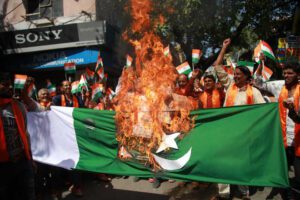
Perhaps the greatest success of the BJP is not in rewriting India’s laws or reshaping its economy, but in
convincing an entire generation that exclusion is not a betrayal of the nation’s ideals, but a fulfillment of
them.
Yet even the most carefully constructed myths eventually encounter resistance. The 2025 India–Pakistan conflict, triggered by cross-border strikes and escalated by a show of military strength, marked one of the rare moments when Prime Minister Modi’s leadership drew some domestic and international criticism. Once hailed for his command of foreign policy, Modi finds himself facing questions—not merely about tactical decisions, but about the ideological rigidity driving them. What had once been admired as resolve now begins to resemble hubris. And in the moment of that fleeting uncertainty, a deeper unease emerged: has India, under the BJP, traded caution for bravado, and inclusion for dominance?
Nationalism, when fused with statecraft, thrives on the presence of an adversary. For decades, the BJP has
positioned Pakistan as the external threat, and Indian Muslims as the internal one. For India, in this paradigm, dissent became sedition, diplomacy became war-posturing, and identity became a battleground. The Pahalgam Attack did not create this environment — it laid it bare.
This moment, while unlikely to fracture the BJP’s formidable base, nonetheless offers a glimpse into the
strain that accompanies majoritarian governance. An ideology that builds its strength by defining enemies must always be searching for the next one. And a nation led by such an ideology risks forgetting not only its founding promises, but its own capacity for reflection.
The attack on Pakistan in the wake of the Pahalgam incident is one of the many tragic consequences of the
BJP’s Hindu Rashtra nationalism. The Pakistani people have never been equivocal in condemning terrorism, and Pahalgam is no exception. Yet to the BJP, such incidents are a godsend: tools to reinforce and recycle a dangerously false narrative.
Whether this moment becomes a turning point remains to be seen. But it raises a question India can no longer afford to ignore: Is the BJP destroying India from within? Should the nation belong only to Hindus
— or to all its children who have shared this subcontinent for centuries? The hope, still, is that Indians will answer “no” — and answer it in unison.
Related stories
Deleting Pakistan: India’s Digital Ban on Pakistani Voices
How Modi’s 2019 Kashmir Move Laid the Groundwork for Operation Sindoor
How Modi and Netanyahu Use Terrorism and Islamophobia to Justify War